
Mind Dream Season 2: Nic Adams Interviews Allyson Dwyer
[This conversation was conducted over Zoom and has been edited for concision and clarity.]
Nic Adams: Allyson Dwyer, founder of Mind Dream Theater, congratulations on the launch of the second season.
Allyson Dwyer: Thank you.
NA: You're welcome. The theme of season 2 is the semi-quincentennial of our country. I've never said that word before.
AD: I think it's like “quince”.
NA: “Quince”. So after listening to the 7 audio plays, I found so many points of connection between them. Your play's incontinent tinfoil-hat-wearing football fan, and the end-times-patriarchy of Leonie Bell's podcast bros. Then there are the allusions to political speech meant to justify atrocities in my play, Thinking Backwards, the backwards text, like, "freedom your hate terrorists," which, as reordered forwards, is "terrorists hate your freedom," right? And in Alyssa Haddad-Chin's play I heard the phrase "I have the right to defend myself," which is something we’ve been hearing a lot from Israel on the justification for genocide of the Palestinian people. Then there's the violence of ecocide in Caridad Svich’s play. The quote I love was "I look out at where the trees used to be and yell fuck!" There's the violence of state in Kenneth Keng’s, "the Republic shall endure, sir." Then there's the slippery double entendre of Ben Holbrook's There Is Only My Voice, which is at once a satire of wellness-as-opiate-for-the-masses and also this insistence that we remember that collective power begins with using our voice.
Throughout the Mind Dream audio dramas, I'm reminded of bell hooks' diagnosis that oppression travels as a quartet - the imperialist, white supremacist, patriarchal, capitalism, right? I'm reminded of the Georges - Carlin and Orwell - of “doublespeak” and euphemism, and how language can be used to manipulate. I'm reminded of Lawrence Ferlinghetti's quote, "I am signaling you through the flames" from his book, Poetry As Insurgent Art. With all this as backdrop, I'm wondering about your sense of occasion with this season's themes as both producer and writer. I think many artists that we know are - for very legitimate and understandable reasons - fatigued by our nation's politics and leaders, and are choosing to avoid the topic of America’s 250th and all that carries in their artistic work, sometimes for security. So, as the producer of and contributing playwright to this Mind Dream season 2, Allyson Dwyer, why do you choose to lean into these topics?
AD: Wow, what a beautiful send-up to the season. I am so moved. It's complex and simple all at once. Basically, as you were talking, what my brain went to is that, yeah, we live with so much noise. We're surrounded by technology where people can say their opinions on anything at any moment, and so we're kind of tired of hearing all those things. But at the same time, that means people shut up more because there are so many people talking about politics and commenting on it. So with the season, I was excited by the idea of going to very thoughtful artists and writers and saying, "hey, what are your feelings about this occasion?"
That's the answer to your question now. Before that, what inspired the America 250 season itself was that I learned it [America 250] was happening because I had no idea until last year, and I was like, oh, okay. And then also very famously, the NEA grants were rescinded from a lot of organizations, and that really angered me. At first, I thought, whoa, wouldn't it be funny if Mind Dream Theater applied for an NEA grant after… Well, I guess I should go backwards. They said "We're going to prioritize and give grants to things that focus on America 250." I haven't actually looked to see if that's even true. But I was thinking, "Wouldn't it be funny if we applied for a grant like this but from artists that are ready to be scathing, or have something to say?" But obviously we couldn't do that, because we're not really that big of an organization. So hypothetically, if I could ask this group of people, how would they?

NA: And as an artist yourself?
AD: I always ping very violently in my art between being extremely sincere and then just being really goofy. So for America 250, this was a no-brainer even though I write very sincere things. I'm very angry about the state of the world and politics all the time, which, you know, everybody is. I think it's just been with me for so long now that any chance I get to talk about these things, I want to.
And specifically with the episode I wrote, Wazzup, I'm very fascinated by, for lack of a better word, the deep state. I know that kind of sends out dog whistles. But over the pandemic, I kind of gave myself a lot of brain rot reading books about the inner workings of the government. Books like The Devil's Chessboard and Family of Secrets.
NA: I'm thinking of the...what was the big United Fruit Company book?
AD: Oh, I don't know that one.
[Nic is referring to Bananas: How the United Fruit Company Shaped the World by Peter Chapman about the company, which operated in Guatemala, and the Dulles brothers, who, through their work for United Fruit and in the CIA, colluded to depose the democratically elected Guatemalan president Jacobo Arbenz.]
NA: In any case, I'm with you on a lot of this history of CIA intervention abroad. And that is public information that anyone can verify, you know? But it wasn't at the time it was happening, which is evidence of some sort of collusion, some sort of “inside job”, if you will.
AD: Oh yeah, there's this great podcast called American Exception. It's also a book by this guy, Aaron Goodman, and his thesis is basically that there's this sovereign state that exists within the United States government that controls the actual politics of the country. And yeah, it goes beyond that, to not just, like, "oh, conspiracies," but the actual material pain of what this has done to the world.
NA: Right.
AD: There's this other book, The Jakarta Method, which made me cry. I had to put it down and go back to it months later. It was about the forces that colluded to stop the PKI [Communist Party] in Indonesia in the 1960s and the violence that that wrought. With Wazzup, it's looking at how these very privileged, cushy people in life sit atop a throne of death. And even though Ollie [one of two characters in Wazzup, played by Peter Mills Weiss] is in a nursing home, it's like he's living a life of comfort where someone's changing his diapers for him, and he's not really gonna ever face the consequences of the things he's wrought on the world.
NA: Right. He feels he's earned the right to simply enjoy the football game and the commercials between them. And yet he seethes. It’s not as if he doesn't speak of the atrocities he's aware of. He gives voice to them. And so the audience knows they're in there, weighing on his conscience.
AD: In my head, he knows he's playing dumb on purpose. And he's been used to it for so long, throughout his life, that he can hide behind a cloak or a mask and things will turn out okay for him. And even if those things are on his conscience, it's almost like he's saying those things because he knows no one will ever believe Book [the other character, played by Catrin Lloyd-Bollard] if she were to be like, "Well, this just came out of his mouth!" In a way, to me, that was America in a nutshell, was this Ollie character.
NA: Totally.
AD: I'm really curious about your play, Thinking Backwards, because with Wazzup, like I was saying before, I tend to write very sincere things, and instead I wanted to write a goofy thing. What was your approach to the theme? When you received it, were you immediately like "Oh, yes, I've been dying to write this!" Did you grapple over it, or did you sit with it?
NA: There are two ancestors of Thinking Backwards. And they represent the two halves of the play I turned in for the commission. What they share is a sort of insistence on mythologizing the contemporary New York City or contemporary American experience of being an artist. Both of those things are present in the beginning scene and the end poem. The first ancestor is - I wrote this long-form epic poem in 2017 called Icarus in the L.E.S., which supposes that Icarus didn't die when he fell from the sky, but he landed in New York City's open-mic poetry scene and tried to become a legendary poet. And his universe is populated with figures from mythologies from all over the world, and the art world celebrities and literati that modern readers would be aware of, too. Like, they all intermingle.
So there was a character in that piece from 2017 named Jo Sue, and Jo Sue was a character that my friend Rebecca Robertson and I devised together leading up to me writing Icarus. I was tickled by her creation of Jo Sue. And that character didn't get a whole lot of stage time in Icarus. So part of me was like, “I'd love to work with Rebecca again. And I'd love to revisit that character who's this ancient, sexy, funny, hyper-literate artist who’s seen it all, you know? And then the second half of my piece is this epic poem that features all these fragments of texts I hope are somewhat recognizable in an American media diet that I have rearranged backwards as a way of reclaiming and perverting and corrupting some of the awful shit we've been forced to listen to for the history of America. And my experience of the last 10 years has been this amplification of open-mouthed hatred and bigotry that has just become so normalized. So as a citizen-slash-artist, I've been collecting these phrases for the last 10 years and asking myself, “Is there a way to turn it around and create something new out of it? That lays bare its ugliness? Is there a way to play the dog whistle backwards so that there’s no mistaking what's beneath it?” That is the language experiment I wanted for that concluding poem of my piece.
AD: That's so beautiful. I have a couple thoughts on your episode. I could literally write an essay about it. But just jumping off of that point, it's interesting because these characters, Hosanna [Jo Sue’s new poetry persona] and Aesop - well, especially Hosanna - they kind of exist outside of time. It makes me think of, like, okay, don't laugh, I thought of a Marvel universe, but for literature, right? Which I think is so fun.
NA: That's the inside of my head, Allyson!
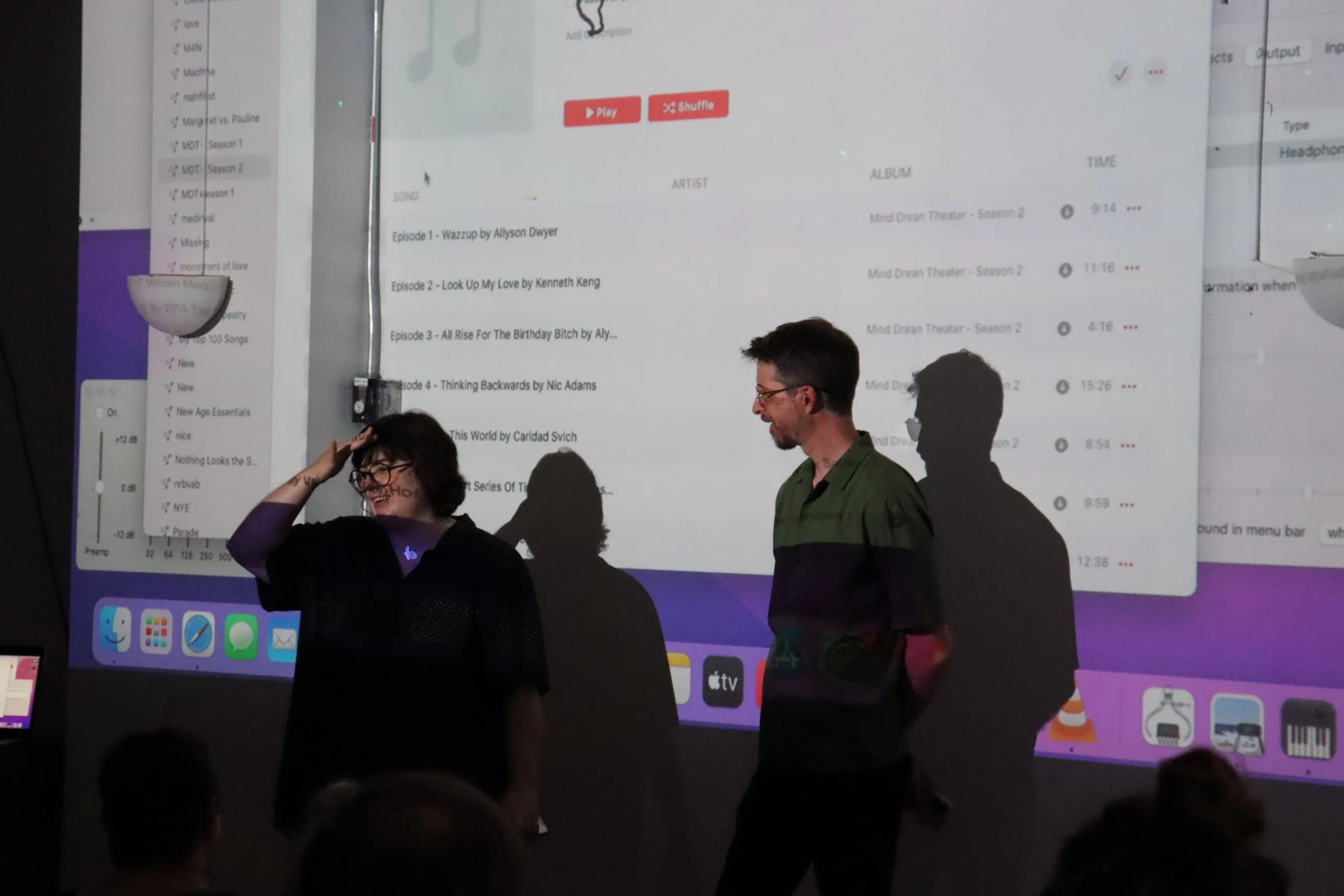
Allyson Dwyer and Jerrod Jordahl Introducing Mind Dream Season 2 at Brick Aux
AD: Which I love! It's so clever! And I think you could go so far with that. There's all this discussion about how reading as we know it is dying. I grew up at a time where it was really cool to read, and it was really cool to be like, "I know about The Odyssey," you know, Christopher Nolan movie notwithstanding. But The Odyssey, or The Inferno, or take your pick, Paradise Lost, or something like that, where there's a rich bedrock of literature that we then build on top of. And I think there's a subset of Americans that pride themselves on knowing these things. There's this fear that, at least to me, that that would go away. I know that sounds a bit pretentious, but it's also part of human history. So the reason your episode excited me so much is that it's such an appeal to this imaginary listener in my head that if they came across the episode, they would be really intrigued by this concept that tickles their brain. This goes to a bigger part of the Mind Dream mission. I think a lot about how people are scattered across the world, or across the country, and they're not just all in New York City. There's someone who might listen to this; maybe they live in Kansas or Texas or wherever, and they're really excited and feel seen by it.
NA: I'm so glad you brought that up because I've been thinking about that a lot with my episode in particular, and while I'm so glad to share it with my peers, and so glad to share it in this community that you've brought together, I'm also so excited by the potential that this could reach someone I've never met across a generation or two, who's asking, “Does it matter that I have a relationship to a literary canon?” Not to say that my piece is great literature, but that it's full of allusions and references to it, and really puts that stuff on a pedestal. And Thinking Backwards is also not without its ordeal. My piece is like a puzzle, pretty intentionally so, and I hope pretty plainly so. I hope it's accessible.
But it reminds me of something that Paul Lazar said about watching Richard Foreman's work, either on his podcast, Talk to Paulie, or OK Radio by Nature Theater of Oklahoma. He said that watching Richard Foreman's work was an ordeal. And he said, “I don't mean it's a chore.” He meant it's something that you have to struggle with in order to get something out of it.
AD: Everyone was really intrigued by yours, I think because they went on the journey. And I appreciated that so much. I think everyone did that in a way with their episodes, which makes me so proud. There's this very intense trust of the listener to just go on a journey, which all my favorite theater does.
But yours specifically is American in this way because it's dealing with, I think it's a very important topic right now, about literacy and the American struggle with intelligence. There is an attack on being well-read and intelligent in this world -
NA: Yeah, and some people are surrendering.
AD: And people are surrendering, and you have to actively fight against it, and value your own brainscape. A part of America that we don't engage with enough is reminding people of their own intelligence. And I think you do that beautifully though, kind of shamelessly - I say that in a complimentary way - by grabbing what you can and playing with them like dolls. It’s very theatrical for a soundscape. Anyway, I just had to get that in there.
NA: Thanks, Allyson. Well, speaking of journey. Writing in CultureBot, season one Mind Dream Theater playwright Theresa Buchheister wrote about fellow season one playwright Jerrod Jordahl’s piece, "Without leaving my bed, I was able to go somewhere wild just for a bit and remember my frailty, my humanity, my oddity before flopping back into the rest of my day."
I want to talk about the sound journey Buchheister wrote about. The sound design for most of these pieces is pretty psychedelic. And often in this season the psychedelia is more like a bad trip than a good one. Given that most of these were designed by separate sound artists, what does this emerging, shared Mind Dream Theater audio aesthetic say about our community and its concerns?
AD: Going back to talking about intelligence, and I don't mean the good intelligence, I mean, like, government intelligence, it makes me think of that era of the later 60s where everything became a bad trip. Or speaking of those books I was talking about reading before, there's one I read called Chaos, which is about Charles Manson and MK-ULTRA. Anyway, this is a roundabout way of saying history repeats itself, and it feels like maybe we're in one of those eras, again, where…Let me backtrack. So, I'm very into the JFK assassination. I'm fascinated by it, because it does echo with today, right? I didn't live then, but you had JFK getting assassinated, and then, of course, MLK getting assassinated, and Bobby Kennedy —
NA: And Malcolm X.
AD: And Watergate. An American history where people became very jaded. And somehow, I don't know how, we kind of rappelled off of that and forgot about it over time. And something just feels very salient, like we're back in those times. A big trigger for that was the Epstein files. But even before that, with the expansion of the internet, people and the way we get information, the way we understand truth collectively, we're in an era of everyone deciding reality for themselves. We're in a very psychedelic time. I love that Mind Dream Theater evokes that because, in a way, each episode is a reflection of each writer's mindscape.
NA: Yeah, and in different ways, I'm thinking about Caridad Svich's play, the distortion of the voices, and then I'm also thinking about Leonie Bell's almost vaudevillian, silent movie scoring and foley. There are so many different expressions of the “bad trip”. But like, so few of them are aiming to delight or pacify?
AD: Yeah, even Alyssa, who - her work is so funny and kind of jovial - and behind it there's a darkness, which I really appreciate.
NA: Ben's is really funny. The sound design is simple and surprising.
AD: Yes! Ben's is…and I explained this to Ben, the reason why I selected it as the final one is because it felt like the most hopeful. It's funny. It’s also beautifully cynical, because you've got, and this plays into the psychedelic theme, that we're living in a time when everyone thinks their voice is the only voice, and we're all competing with each other. But at the same time, the episode ends with them singing together, which I found to be very theatrical. You've got these different voices, and somehow they end up together, and it doesn't need to be explained to you, but you feel it in the production.
NA: Totally. Yeah, it's magical. It's the last thing you would expect of all those voices, who spend most of the play competing with one another to be the "only” voice, right?
AD: Yeah, and almost like you have to accept that maybe we are all different souls and different voices coexisting at once. Which is very true to Ben, which, again, is why I asked everyone specifically, because I knew everyone has such strong voices and points of view. Leonie's is so phenomenal, especially if you're someone living nowhere near New York City. When you listen to it, it's like you're watching a Leonie Bell play. But you're just feeling it through sound, and that really is exciting.
I wanted to ask more about Thinking Backwards. Did you write it thinking about the production? Like, did you know you were going to sound design it yourself? How much were you thinking about sound when you wrote it?
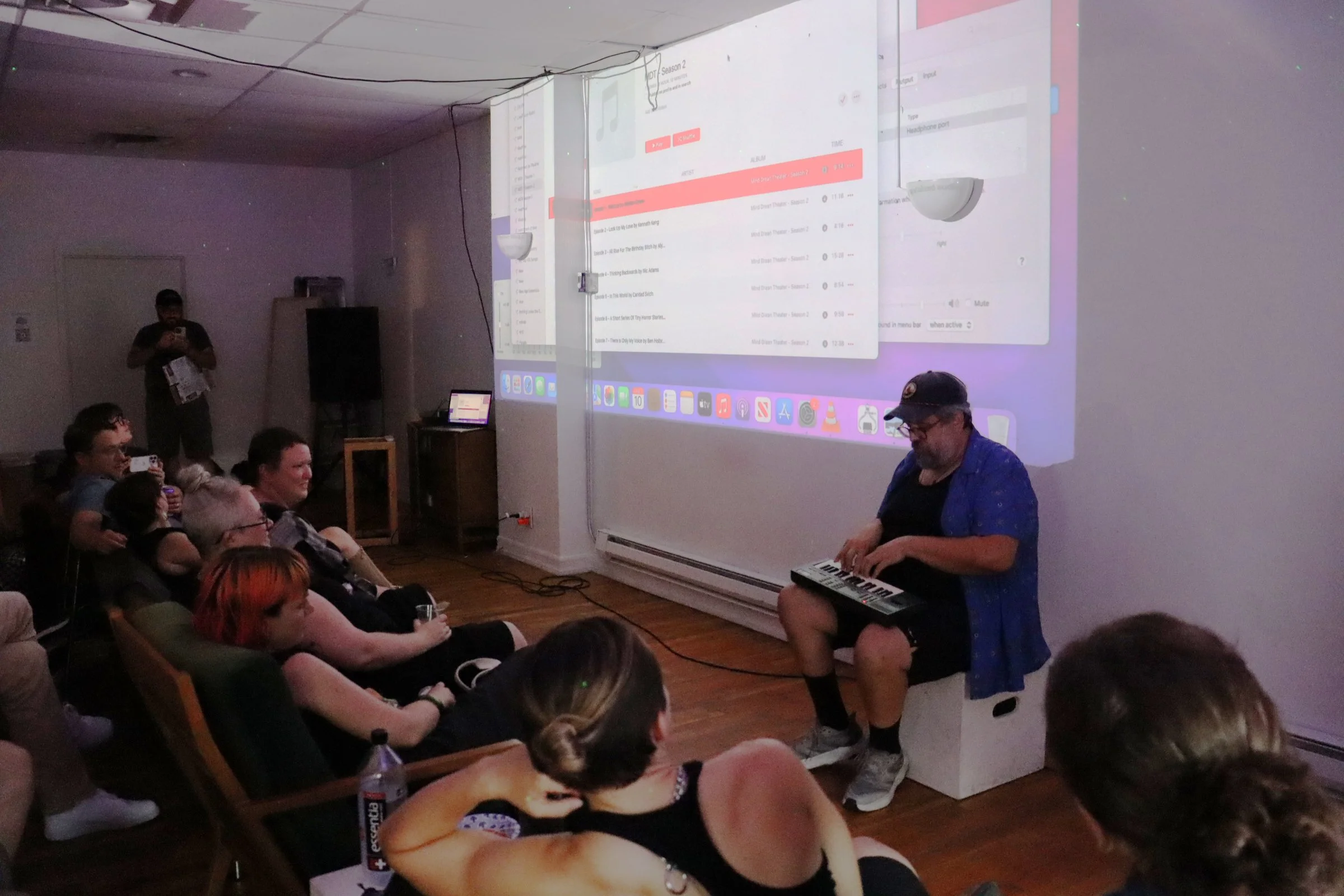
Devon Wade Granmo playing the Mind Dream Theme Song at Brick Aux
NA: You gave me some really great feedback on the first script I turned in. I write Talky Shit with a lot of text, and most of my work for a digital medium, like Corona Cam Show or Bun in the Oven - which I made with cabaret performer Lee Rayment - is Talky Shit. When I wrote this epic poem, Icarus…when I did my play at Exponential in 2025, NECK DOWN…it's people yapping.
So, I turned in a draft of Thinking Backwards to you, and I had probably written only five stage directions referencing the sound design. You know, “an atmosphere of” this, “an atmosphere of” that, “sound cue of” this. And, gently, you asked me to look for opportunities to expand that atmosphere, that element. So I took the play to Shaun Leisher, who's a director and dramaturg, and I asked him to read it and pitch me on sounds that he thought would meet the material in some way.
AD: Interesting.
NA: I already had perhaps an unwritten or unexpressed knowledge or instinct to build to a cacophony like in the sound design you hear at the end of my piece. And Shaun added some elements to that that really helped me break the binary of my play. Shaun’s feedback helped me build a bridge of sound design between the first half - the scene work - and the more abstract use of sound later in the piece.
And I'd like to say that the final composition that underscores this epic poem - which is read amazingly, dramatically, funnily, beautifully by Becca Blackwell and Rebecca Robertson - that piece of music that scores the poem was made by myself and my brother, Jack Adams, who's a musician, and was just an extended jam we did a few years ago. While I was editing the episode, I reached out and was like, "Hey bro, do we have any of those really out-there jams that we made together that you'd be comfortable sharing?" And he was like, “How about this one?” And there was something really cursed about the one he sent over. So I used it.
AD: Oh. That's so beautiful. Another reason I felt so driven to start this theater is I was thinking about it as another opportunity to be creative that didn't necessarily involve too much time, or physical energy, or, for lack of a better word, effort. You could literally just contact your brother and say, "Hey, I have this thing I'm doing, can I use this piece?" Did you get a sense of that, that you got to be creative in a different way? How did it differ from working in theater for you? Regular, old, live-action, in-the-flesh theater?
NA: Yeah, that's a beautiful question. And thank you for the invitation to join this season of audio work. There's a spirit in your invitation to me, and Leonie, Ben, Alyssa, Caridad, Kenneth…your invitation is one degree of separation, two degrees of separation in this community. Like, it really does feel like a yearbook of who makes work in Brooklyn right now.
I took the spirit of your invitation, and I turned around and made invitations to my loved ones to make Thinking Backwards. So I invited my brother. I invited Rebecca Robertson, who I've known since I was 12. I turned around and invited Becca Blackwell, who is someone I've collaborated with a little, but have admired for decades. And I invited my girlfriend, Angel Desai, who's an enormously talented actor and musician, and also an activist through her work with the Asian American Performers Action Coalition, and a brilliant director. With my collaborators on this piece, they’re all half badass artists, half people that I've been in love with for a dog’s age.
AD: I kind of suspected this when I invited people, that it was going to gravitate towards usual suspects. When I invited Ben, it's like, of course he worked with Nate Weida, of course he worked with Cristina Pitter, and Thea Brooks, and Andrew Butler. Same with Kenneth working with Carlos Enrique, Alyssa Haddad-Chin with Adam Kassim, and so on. I had this suspicion, and I think that also led me to be like, okay, this would be a fun snapshot to capture these really wonderful little communities of work happening, because it's not like everything everyone's making in New York and Brooklyn is an amorphous blob. It's like a garden where there are different flowers of different groups of people doing things, and these are all just sound images of those flowers.
One particular person I definitely want to make sure gets a shout-out in this interview is Hannah Birch-Carl, who is a dear collaborator to me. She is primarily a sound designer, but she's done costumes and props for me, and she's just got a wild, funky brain that I adore, and working with her on our episodes has been very inspiring, and I trust her so much. Even with Wazzup, she made some choices that I didn't originally think of, including making it so that Book, the character Catrin [Lloyd-Bollard] plays, is in a kind of hazmat suit, and just adding little things on top that I wouldn't have thought to.
NA: Speaking of this collective - so beautifully manifested in Leonie Bell's piece, A Short Series of Tiny Horror Stories, which features as actors all of the playwrights from Season 2, with the exception of Caridad Svich - and these, like, deep, long collaborations you've had with Hannah and Ben and Christina Tang, this Mind Dream Theater season resonates with the work you write about in your stage plays: how the isolation and anonymity of the internet can radicalize people, the way internet addiction manifests in different generations, and the hopefulness of this truly lowercase d, democratic, pluralistic, polyphony of voices…I love how Mind Dream vibrates within your artistic output as a playwright.
I can trace the history of my politics to studying Howard Zinn in high school, the hypocrisy of nativism when our country's economy requires poverty-wage labor, as expressed in the border politics of California and Arizona. I studied abroad in Mexico in high school and Guatemala in college. I guess my question is, I've noticed that there's a collectivism that is present in form, content, and production in your plays and in this season of Mind Dream Theater, as a manifestation of your vision, artistically, and as a producer. Is collectivism important to the work you and Mind Dream make, and how intentional is that as a practice for you?
AD: Oh, boy. I mean, again, like with all your previous questions, I'm extremely moved by what you're saying and how you framed it. I think, yeah, everything about that has been intentional, very quietly to me. It's just something I hold with me at all times, and I don't know how I got it or how I learned it. I don't know if it's because I'm a Cancer or what, but the things I feel and believe I take very seriously, and I definitely try to live by them. I don't know if it's from growing up watching anime and Ghibli movies, but I would say it definitely is connected to even just growing up online. When I was younger, I want to say pre-teen age, I found a chat room that was dedicated to this animation block on Cartoon Network called Toonami.
NA: Oh, I remember that.
AD: I think most people have that thing from when they're young that triggered their brain and rewired it in very prolific ways. But in finding that chat room, it was almost like I left my body and was always connected to these people in ways that went beyond anything. I was always thinking about them; I was always wishing I was with them. And the mechanism of a chat room, typing into it, it felt like theater to me.
And then moving forward, in my 20s, like a lot of people, I was pushed and prodded by politics. I think it definitely started with Occupy Wall Street, and, you know, "We are the 99%." That always stayed with me; it still does. And then Bernie Sanders, of course. And then just arriving at theater, I'm so inspired and moved by the community at large. I learned a lot from Theresa [Buchheister] and The Brick about what it means to be present in community; it's been something that has driven me. I think it's okay to admit I'm not the most secure person. I think a lot of the pain I've felt in my life, I try to make sure other people don't feel it, so I'm very pushed by this idea that everyone can feel involved and accepted, and that it doesn't matter where you're educated, but if you want to create, and you want to be present, and you want to be there, you should be.
This also goes back to our conversation about Thinking Backwards, which is this idea of pretension, and that some things are for some people and not for others, and I just, I deeply disagree with that. I love being “pretentious,” I love watching Criterion movies, and reading weird books, and going to weird plays, and I feel like everyone can do it. It's not just for us; it's for everybody. I love this idea that maybe we could keep the spark alive that says you can be weird and make things, and it can be ubiquitous and not just for some people. I hope all that congealed into a coherent thought.
NA: I think that's a beautiful way to begin to wrap up, which is that you have, not only as an individual but as the catalyst for this collective, made opportunity for people to grow their community, become less isolated, and continue this American tradition of creating these artistic works that audiences grow from.
AD: Yeah, and it does connect back to the internet, and this idea of fighting against what it's become. Even going back to talking about chat rooms and things, I refuse to be like, okay, this is what it is. I think by making these digital plays, it's just a little bit of a flag saying we can put this stuff out, and it could exist here, and I think that's also what Mind Dream is about.
NA: My sister says sometimes it feels like no one is having fun on the internet anymore.
AD: Hahaha. I mean, yeah, right? I think about that, too.
NA: And you have done your part to keep the slop at bay - keep the mainstream, polished, AI, Photoshopped, unreal at bay - by creating this uncontainable, ungovernable platform for wild, rigorous artists and writers. And through your mission to create a property-less theater - “where the venue is your mind” as theme song writer Devon Wade Granmo sings - you've guaranteed that that work can be accessed and found by, and will reward, the kind of curiosity that brought artists like you and me to this contemporary New York City moment and place, to make some cool shit. You’ve done such a beautiful service to our community.
AD: Yeah, I hope, I definitely hope so. And going back to intelligence. They can't touch your thoughts, you know? Just because everyone online is succumbing to whatever it is doesn't mean you have to.
Audience listening to Mind Dream Season 2 at Brick Aux
NA: I tell that to my writing students all the time, told to me by Sibyl Kempson — this [touching his temple] is the one thing they can't take from you.
AD: Yeah, yeah, that's totally it. I think it's like a call into the world with it, and my hope is these plays reach other parts of the country, other parts of the world. It's just the beginning, but my hope is not only for other people to find it, but maybe eventually other people in other parts of the world can contribute. Hopefully it's not always New York-based, but I guess for now it is, just because I know so many wonderful writers here, but I know they're all over the country, and so that's the next phase, branching out west. Like a true American.
…
Nic Adams (he) is a playwright and cultural organizer. Presenters include We Are Here, Judson, Joe's Pub, The Bushwick Starr (produced by TMT), JACK (with Oye Group), and The Brick (Weasel Festival). Funders include the MAP + Venturous Theater Funds, NYSCA, the Anna Sosenko Assist Trust, and NYFA. Producing Director, The Exponential Festival. MFA, Brooklyn College. nicadams.com
Allyson Dwyer (she) is a theater artist from New Jersey and founder of mind dream theater, where the venue is your mind. Recent plays include u are the dream (Exponential Festival, The Brick, Most Unwanted & mind dream theater), Arrow of Time (1319 Press, Exponential Festival, mind dream theater, NYC Indie Theater Film Festival, Young-Howze Theatre Journal Awards Best Audio Production), Extraordinary Machine (EST/Sloan), Gumshoe (Arthouse), Plato’s Gooncave (?! New Works at The Brick). She is an alum of Clubbed Thumb ECWG, Soundlab at The Brick, The Road’s UC4, The Alcove at The Lucille Lortel, and Arthouse Inkubator. Say hello: allysondwyer.com