
Paul Pinto and Object Collection (Travis Just & Kara Feely) in Conversation
Travis Just
Okay, it's recording, so it's official. Now everything's on the record, and the CIA owns it all. The last time we did this, Paul, was 10 years ago. So how have you been?
Paul Pinto
My God, well, there's some times where I feel like I'm so old, and there are other times where I feel like I just graduated college and I don't know what I'm doing. I don't know if that resonates, but my brain has been mushy in really interesting ways the last couple of years.
Travis Just
I try to exist in a permanently juvenile state. I’m gonna hold on to that for as long as possible.
It seems with Mano a Mano, it was hard to tell if it was a generalized approach to storytelling or if it was two competing approaches to storytelling that were being set up in comparison to one another. I don’t know if source text is the right idea, but the two dominant source stories are Beowulf and Gawain, and I don't know if you were trying to set off methods of telling from each of those in addition the characters themselves.
Paul Pinto
I realized I started writing this piece before the two of them were the main characters. They were like vignettes, things about masculinity and about self reflection that I really found powerful. They were autobiographical and sometimes a little masturbatory, a little self serving: this is about me and my body. And so after taking a break from it, I found through lines and rewrote it. And in that rewriting, zeroed in on masculinity as I want to explore it as told through these two tropes, these two stereotypes.
Travis Just
it's funny that the way that would manifest is through these centuries-old stories, instead of the NFL or something. I would have assumed, and I did assume, that you had this overriding obsession with medieval Bardic tales. That you were gettinng into your inner D&D bard-in-the-corner.
Paul Pinto
Definitely both, right? I am obsessed with this stuff, I just didn't think I could write an opera about it. So I wrote an opera about that, plus 100 other things, and then narrowed it by cutting, trimming, editing, chopping. It can just be the story of my childhood interest, and the reason it's not the NFL is just because I don't watch football. If I watched football, I'd make a show about football. I was super into boxing, so this is why boxing is such a big part of the show.
Travis Just
In addition to masculinity, there's the idea of how a story is delivered and what it means to recount histories in the sort of broader sense of a history, which is not necessarily facts and figures, but more narratives and myths that then fall apart, and get constructed, and then are laughed at. Obviously the piece is very contemporary feeling. But these approaches, you can find it in Chaucer just as easily as in the 21st Century. So, it seemed like there was a lot about what it means to tell tales.
Paul Pinto
I'm thinking a lot lately about translation and transmission. Someone whispers a thing, and you remember 90% of it, and then five years later you remember 50% of it. And then, you remember 10% of it, but you can make a whole show out of the 10% that you remember. What parts of it are from the source, whatever that means, and what parts are just this one detail I can remember and get fixated on for 20 minutes.
Travis Just
It's also about how reliable is the narrative to begin with. Obviously, we've been beaten over the head with Western canon, which hopefully we can all move beyond, but in its original state, if we go back to these original, ancient poems, they're not canon. They're just fucking stories. They're just interesting stories about weird and nonsensical occurrences that may or may not be true, probably more likely not true. And in a way, making everything so certain is almost the Great Lie of the last 1000 years, right? And a little more uncertainty might suit people better.
Paul Pinto
It's just what the drunk guy was singing in the bar, you can listen or you can not. The stuff you guys do, the stuff I do, that bombardment is such a huge part of what we do. And when something thins out to, say, a single idea repeated for 11 minutes, it just feels like an opportunity to give context to everything else that's been going on. It's also the two extremes of the things I like to write-slash-perform: durational work that has one simple idea that just goes until it doesn't need to go anymore, and then a barrage of text on the other side.
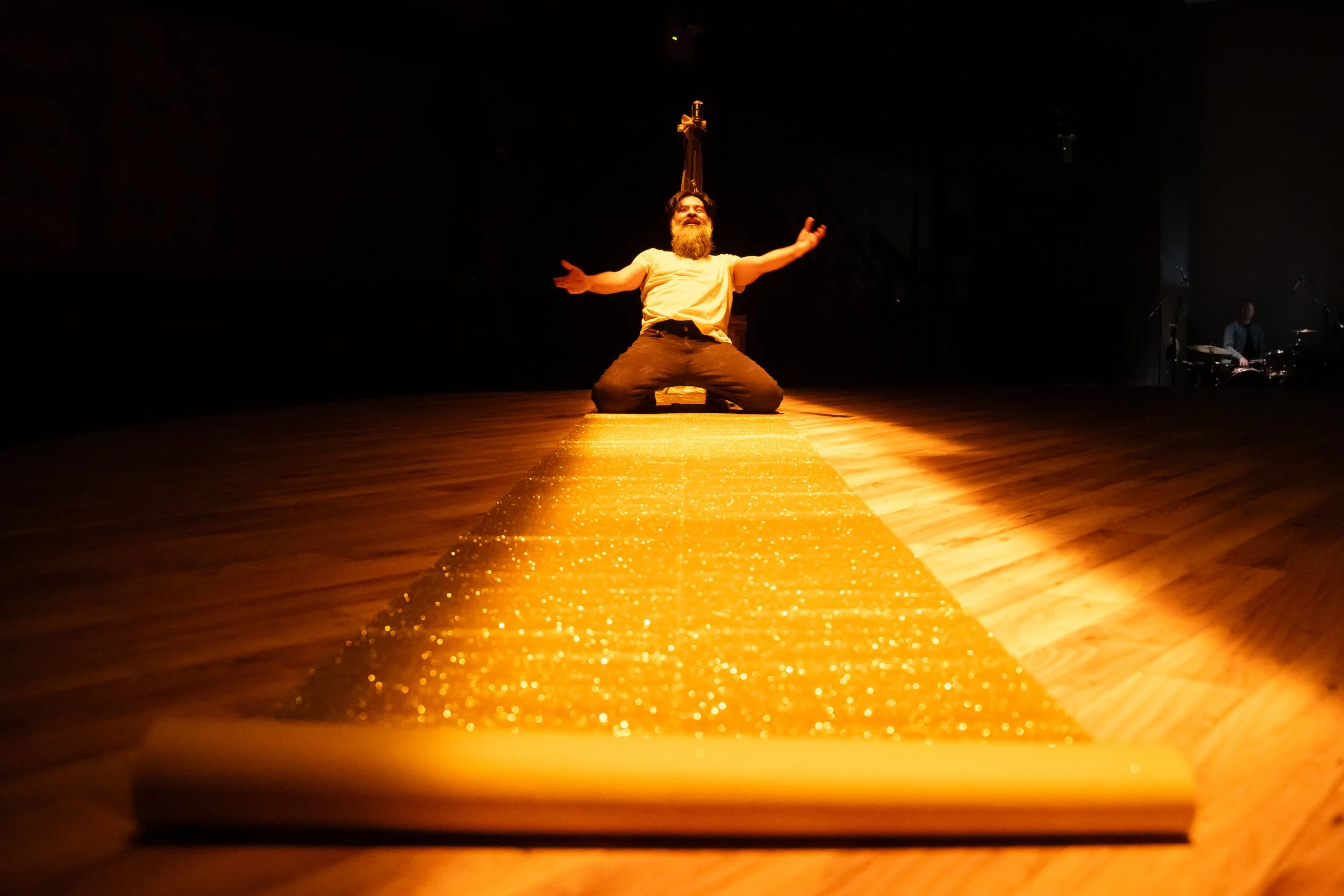
Paul Pinto / photo: Steven Pisano
Travis Just
Do you see Mano a Mano as examining your own being and ego? Because I did not read it that way.
Paul Pinto
That's what it used to be for sure. That's what it was when I started in 2019 when I first assembled a version of this and put it up for a workshop. People liked it. It was cool. I liked it. But then on reflection, I thought, this is not a show about anything else except what I'm feeling about my body and myself at this moment. And stepping away from it for three years and then rewriting it really allowed it to be way more than that. So at its root, I think it is all self reflection. But thankfully, collaboration and time makes it more, makes it a work.
Travis Just
I was wanting to talk about collaboration a bit too. Because a lot of composers take on all the tasks themselves. And they will avoid that kind of collaboration. I was interested to hear about your experience with it, especially doing something that was so personal, but then, opening it up to other people, bringing them in, and, not being the final arbiter of all things.
Paul Pinto
I think we we work in teams even if creating is a solitary act. The first people you share it with are the collaborators, right? So I feel lucky to have shared it with people that believed in it along the way and then added their instincts and their questions and their critiques and their shaping from the earliest collaborators like Jeanette [Oi-Suk Yew]. We were hanging out in Mana Contemporary, doing a workshop in 2019 of this piece. And after the one-day workshop with two days of prep, I remember being moved to tears, because here I was performing a piece that I didn't know that well. It wasn't in my body, but I thought, okay, I gotta put something up. And so I'm rolling around the table, and Jeanette is lighting me. She's walking around with a flashlight, pointing it in my face. Trusting someone to do something with this. I can only take it so far, I have an idea, we're just going to try it. And then get gritty, get your hands dirty and just do something. And how that process evolves with time, patience, and money into a thing that is more fully realized by more people: technicians who support associates who can execute; programmers who can make the MIDI triggers accurate. It all stems from a place of “here's as good an idea as I can make. I've thought about a lot of this, but not everything. Help.” And, and then someone takes it, smacks it one way or bumps it one way, and that's the oldest collaborator. And then Kristin [Marting], somewhere in the middle. After I abandon the project, she comes into it, and looks at the libretto, and says, this could be something more. And pushes me to rethink it and remake it. And at every moment, at every workshop, talking about: connect. How is this connecting to the ideas before and after, but also to the audience. How you transmitting this story? How are you translating and transmitting? And that completely reshapes it.
Travis Just
I think it's also a willingness to step out of the way and know when you don't know something, which can be difficult for composers in particular, and maybe even fits into this idea of toxic masculinity.
Paul Pinto
I think so. it's why a monodrama feels so fucking masculine. When someone says to me “one man show”, I say: oh no…monodrama. I prefer the word monodrama. It's my own baggage. I hear you. It's what a one man show is, like I can do everything: all singing, all dancing, all the shit. It doesn't mean that it's not valuable. This idea of that I want to be able to do everything, and actually the attempt to try to do everything, I think it helps my performance.
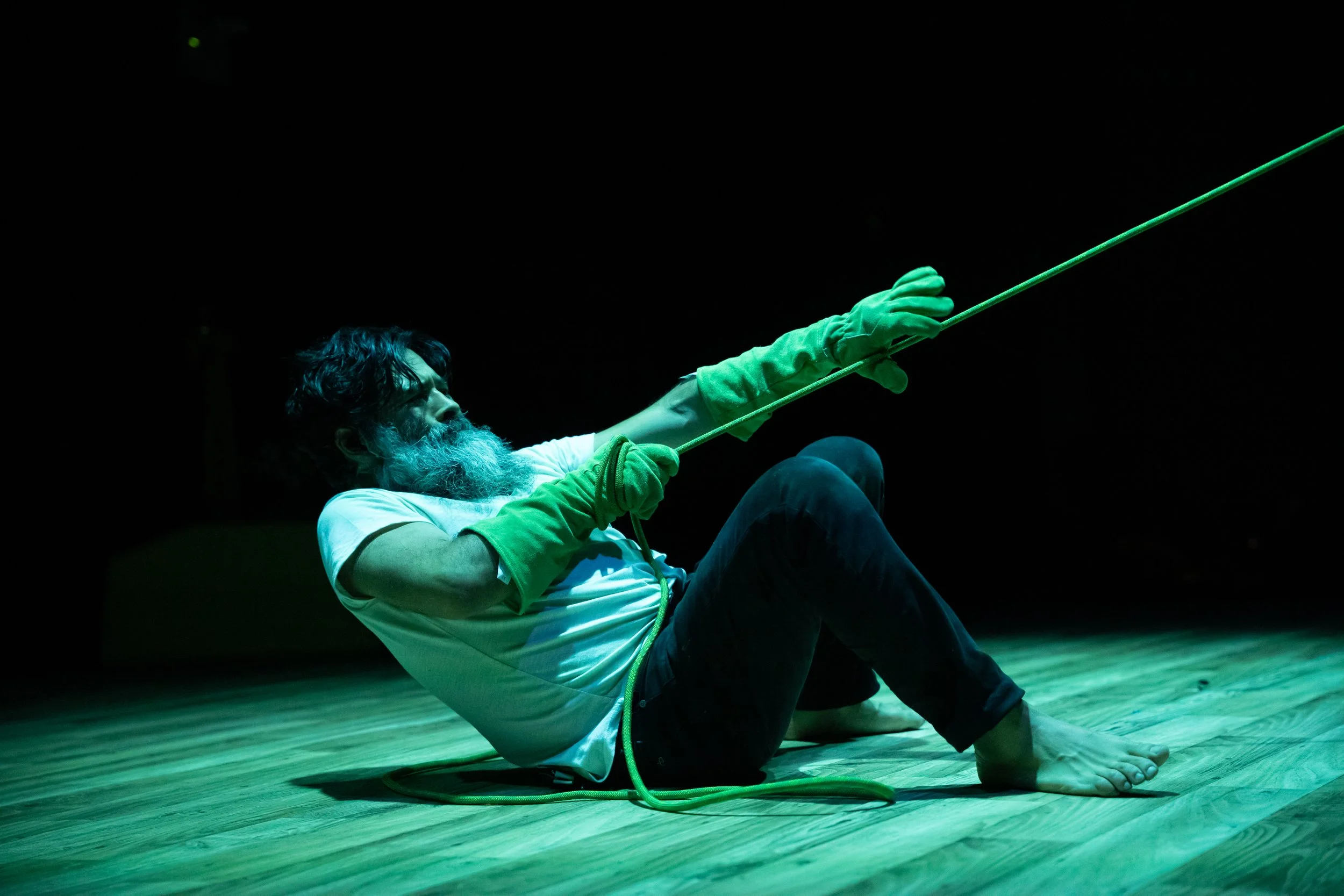
photo: Steven Pisano
Travis Just
There's a franticness certainly in the text and in the delivery. But frankly, those are through lines in your work, whether it's a theme of the piece or not. It's part of your palette, and in a positive way, you know? There's something about it being so much about your voice, too. It's your voice and your body. Those are the first instruments and the first objects, right? So it is going back ultimately to the roots.
Kara Feely
How do you feel performing it every night?
Paul Pinto
I feel tired, but every time I every time I do it, I get closer to the feeling of a junkie or something, where I just want to do it again right away, right after. I think conditioning is so real, and I kind of take it for granted. You write a piece in your 30s, and then you perform in your 40s, and, oh shit, my body's different. I can't just wake up and do this thing.
Travis Just
Now we definitely have pieces where we're not going to ask this person to throw themselves on the floor anymore. It's just not a reasonable request.
Kara Feely
Yeah, now you're gonna slide off the chair…
Travis Just
slowly and elegantly.
Paul Pinto
I'm curious about this. It's really easy to call those things compromises. But how do we renew performance and make it fresh to our bodies? You've been working with the same collaborators for so long, where else has that come up? Maybe in this new work?
Kara Feely
We actually have brought in younger people to sort of balance out the aging. Because we've worked with a lot of the same actors, I have to make sure that I'm not just asking them to do the same things over and over again. Because I get fixated on energies that they have. I know them so well, I know what they do well, and I have to remind myself, oh yeah, we did that the last show so do something else this time. I think that keeps it exciting, because you're always trying to get at what they do really, really well. Sometimes I find things with them that didn't occur to me before, and it opens up a new door. They put on some wig or some outfit and, oh my god, I never thought you would look like that. In HOUSECONCERT we brought in a regular to understudy one of the roles. And he showed up with his hair slicked back and adopted a totally different persona. After seeing him do that we put him in our next show and made him that character. Okay, this is you now.
Paul Pinto
I was thinking about the [Robert] Ashley band, where you see these regulars and then every time they make an adjustment to the expectation, it's mythology-making.
Travis Just
From a writing standpoint, with composing, I don't need to do as much to get as much. You and I, we have fairly idiosyncratic ways of making music and text and drama and whatever. As I get better at it - not that I'm trying to do “a thing”, and I'm getting better at “that thing” - but as I keep doing more of it, I find ways to do a more involved thing but put it across in a more simple way. Or I use a type of shorthand with people. Or realizing that I can simplify something and get the same effect in a given moment, without some kind of unnecessarily fussy notation, or an overly baroque set of instructions. Being able to read the energies and direct them, and also then being able to get at it in rehearsal quickly. And also knowing when it's working and not working, and knowing how to make an adjustment really quickly just having done it for so long. In a way, it opens up greater degrees of complexity and layers. Because I can do the hard things musically and with text more easily. And so I can pick these moments to ratchet up the density. I know how to do that. And there's things that I've learned, between myself and musicians. And working with Kara and working with the vocalists and the performers and the actors. Knowing when to stay out of the way is also big. So, a lot of time with the same people helps. Do you think of your work in the context of a progression of other artistic figures, or in terms of the past? I mean, do you place yourself in some way, or do you place this work in that way? I mean actively, not just in terms of influence, but in terms of where your work situates. Frankly, I was hearing not a small amount of Peter Gabriel and Prince in your performance. Which I would hope you realize I mean as the greatest of compliments.
Paul Pinto
Up is a deep, deep classic of mine so there you go. How am I actively placing? I'm not 100% sure. I don't know if this answers your questions, but I think about what context best serves the work I'm making. Is this a concert hall work? Can it be adapted for a concert hall, or does it have to be in another venue? Somewhat of a programming question. I'm more interested in writing an evening-long thing, being the only thing on the program.
Travis Just
Placing your work within a musical history, I think ties into a theme of Mano a Mano. Maybe not the generative theme, as you talk about your obsession with your body and things like that, but the construction of stories and the construction, or falling apart of narrative, and how, musically, it fits into a narrative that's maybe fallen apart. I think about especially in the 20th century, you had so much seeming development and progression which then ostensibly comes to a crashing halt sometime in the late 1980s or early 1990s. Now, I don't necessarily believe that's true, but that's a narrative that's been foisted on our generation for the last 20 or 30 years. That history ended and art stopped developing. There are no more heroes. And I think: great that there are no more heroes. They were boring to begin with. But somehow the narrative of experimental culture, for lack of a better term, is not progressing. And I'm curious about that. And the storytelling of art makers, in addition to the storytellers of Beowulf and Gawain as they start hoovering up everything that's around them and spitting out something not unlike your piece. There's not really a question in there, I suppose.
Paul Pinto
Yeah. I mean, excited to ditch heroes. Ditching heroes feels exciting. That feels like progress, right?
Travis Just
That in itself is a fundamental theme of the piece. Ditching them by them being beheaded, or ditching them by narratively ignoring them.
Paul Pinto
There are still stories that I love because I read them at a formative age, and now they inform a lot of my practice. Whether that's intentional…I don't know if I can say that I consciously adopt what it means to be a man, whatever that means, from Arthurian stories and Anglo-Saxon poetry. But I can't say that it didn't have an effect, and that there wasn't something about knowing these stories, actually having the knowledge about them and being excited to talk to someone about them. How can I say this in a way that doesn't sound stupid? The work is less about Beowulf and Gawain and medieval shit than it is about: guys, I have been thinking about this for a while, and I am so excited to talk to you about these things and just convincing you how important they are to me.
Travis Just
Well you say that right at the beginning, as you list this absurd waterfall of information, and then, say “I didn't expect you to understand that. And half of it I made up anyway.” Which is a great way to start by telling the audience that you're lying to them and that we should all be on board with that.
Paul Pinto
It's okay to distrust an expert in fear, right? Like, I'm not flying a plane.
Kara Feely
What are the stakes?
Paul Pinto
Yes, that's just it. It's a safe space. Where are you guys in your process? Are you in rehearsals right now?
Kara Feely
Not yet. We're actually doing a really condensed rehearsal period. I think we're only rehearsing 10 days before we open. But we're working on the outline and everything. It's part of the idea of the piece to put it together quickly and have a kind of scrappy energy to it. So the 10 days will be adequate.
Travis Just
It's a nice shift from the past few years, which have been so structured with long periods of work,
Kara Feely
And rehearsals where I just felt, how are we ever going to be precise enough? We don't have enough rehearsal time?
Travis Just
But it still comes together. It's definitely a different way of working, and I like that way of working. A lot of our pieces are sort of atomized and very involved. But I think it's really important to be able to function under many different methodologies. To be able to do something using the most basic of means, and to do it incredibly quickly.
Paul Pinto
One of the things that I deeply remember from our 2015 interview was your talking about your suitcase pieces. We had this exact conversation where we were both in the middle of making big work that took many years to make, and I was saying, “Ah, I want to work like this all the time, where I'm spending years in development”. And you said, “but it's also really great to just have a thing that packs up and then unload it on the day and put it up.”
Travis Just
I'm really envious of some of my improviser friends that just show up, do their set, and then go to the bar. Meanwhile, I'm still putting kill all my stuff into all of its little compartments. It's absurd, this beast that we've built for ourselves. I think it is because we don't always have access to funding and materials, and I don't want to be beholden to that infrastructure. We have more support than we did 10 years ago. We don't have a lot more support, and we're not making a living off of this at all. But the shows are paid for and we give people as much of a fee as we can afford. Most of the money just goes to people, as it should. But if that goes away, I don't want that to mean that I am no longer an artist. The experimental world has contracted in some ways, I think. Not the aesthetics of it, or even in the number of people that are involved in it. If anything, I think there are more people and it's a larger and more open situation now than what I remember from 20 years ago when we started the company. But there are a lot fewer resources. There are fewer venues. And the venues are much more difficult to access. So, there's a lot of DIY out there. When we started 20 years ago, just nobodies, we had access to black box theaters that were fully stocked. They just give us the keys and we'd have 24-hour access for three or four days. Now people in their late 20s, that's not what they get. And that might mean that our way of making work is in jeopardy because people either have everything: loads and loads of stuff and dough and support and critical buttressing or they have fucking nothing. And in the society at large, there's a huge disparity.
Paul Pinto
You mean the income gap has gotten bigger?
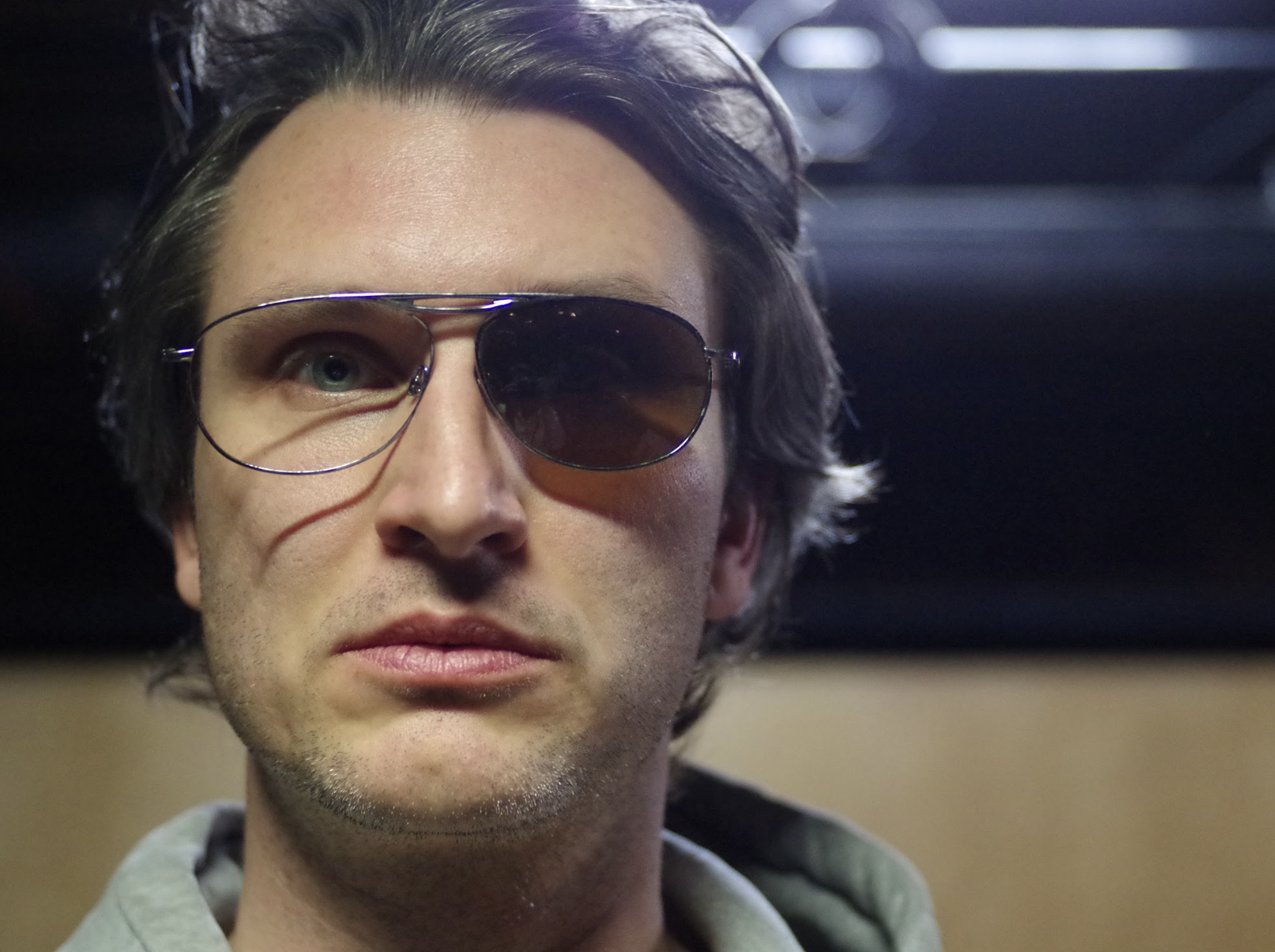
photo: Object Collection
Travis Just
I know, but to see it played out in the cultural field is striking because instead of experimental venues being relatively accessible to relative unknowns, now there's a huge amount of administrative hoops that you have to go through. Or you have to have a certain amount of buzz or interest or this and that. It feels very professional. So I'm very turned off by it. Because if there's one thing that I think is the death of the arts, it is professionalism, and so it just makes me shudder. But I also think that there's a huge groundswell of people that feel, well, it's not open to me, so fuck it. I'm just going to go over here in the corner and do my thing. And if a few people come and if nobody's going to write about it, then fine, we'll just be over here. In a way, it feels very much like the 60s and 70s, where there was no apparatus. It was completely pushed to the side. As opposed to that weird moment in the 1980s and 90s, where all of a sudden, there's money, people have these fabulous apartments, and they're getting all these awards and grants. They're touring the world. It's like, what the fuck? It wasn't like that 10 years ago, and it's not like that now, just that weird bubble in the middle there.
Paul Pinto
I guess that that's all well and good. If I think big picture, which I sometimes do, but I wonder in our own practices, do you feel that you've gone through golden periods? Or do you feel that there are moments where things are really aligning? For your own career, for your own work, for your own practice?
Travis Just
No. I think it's just a stubbornness to simply not stop, maybe a stupidity to not stop. Just sticking around in the face of it all. We have a small audience, and we have some people that are interested in our stuff. But by and large, we are very much ignored and out of favor, especially here in New York, and have been the entire time. But we're 20 years deep in this fucker. There's no going back now. I don't know how to do anything else at this point, I mean, that ship has sailed. There is no other alternative for me at this point. So this is it.
Kara Feely
It really doesn't feel like there's ever been a moment when it's been easy and things have been just rolling into the next thing.
Paul Pinto
Yeah, well, I wonder about this, because, my wife reminds me that I'm always stressed, and though it doesn't feel easy that doesn't mean that you're not in this golden period. I guess there is something that has entered my mind about nostalgia that is new since having a child. I never used to really reflect on where I've been, but since having a child, I do that so much, and so it's really easy for me to look back and to think about golden periods. Because they're rooted in what I was doing at home versus what I was doing while not at home. And when Jonah was four, he was in a stroller, and we were going for walks, and I was composing in my head, as opposed to at a table. And I think, wow, I didn't have any pieces performed for a year, but it was a golden period in terms of a new way I got to think about music making and writing something I don't know, the reflection where I've been. This is a new thing for me, and I wonder if that practice of reflection is more present in your work.
Travis Just
I think there needs to be a separation between a creative sensibility and, for lack of a better term, professional sensibility. Creatively, absolutely. There have definitely been periods where it felt like artistically, things were coming really easily, and there were just too many ideas. And then there have been periods where it felt like “this piece is such a slog. I hate every choice I'm making, and I'm convinced it's terrible.” It's such a cliche, but then the piece happens, and I'm still pretty unconvinced by it, but for some reason it does better with audiences, or my friends, who are really the only audience that I actually trust. The people that will tell me, that wasn't very good, or that was great.And then when I look back at the work a few years later, I look at the material and I think, it's not so different from those pieces that felt so fluid and easy. One year might be much easier than three years later, for no apparent reason. Just drawing the same connection, or finding almost literally the same compositional solution. I find that kind of thing all the time. But I think our place in the world and the practical realities of making work hasn't changed for us. That's never been particularly easy, and frankly, at this point, I don't ever expect it to be.
Kara Feely
When I was saying that it's always been difficult, I guess I meant just in terms of navigating the professional opportunities and getting the gigs. But, in terms of making the pieces, I think we cultivate the difficulty. I think we make things more difficult for ourselves, probably than we need to be. We're always making choices and asking, why? why are we making this is so complicated? I feel that's just our tendency and that's the good difficulty part. I feel like if there isn't a certain level of complexity, I haven't done the piece.
Paul Pinto
Because you brought up the term experimental, and you were talking about your lineage, and, what experimental work was…I've struggled with carrying this identity a little bit. So I'm curious about what you said, how you see it as experimental? What are you experimenting with in this new work you're making? And how important is that?
Travis Just
For me, the word experimental is a shorthand. There was a long time where that's what we were told in the scene, that it is experimenting and blah, blah. It's like, when I'm on an airplane or a bus and somebody says, what do you do? And I say, I'm a musician. Most people, if they looked at what I did, they would not see “musician”. Or I say I work in the theater. And in their minds, something happens that's wonderful, and I'm so happy for them that they're having that thought. But, what we do is very much not that. It's just a shorthand. So, the word experimental is just a way to get through it. I guess I mean something that's well out of the mainstream. I'm not interested in the mainstream. It has nothing to do with with us and I have nothing to do with it. We just have mutual disinterest. And I find it really easy to just sidestep out of it. So for me, this kind of art and music is just stepping outside of those rivers of expectation, and thought, and way of being, and way of thinking, and way of having your thoughts shaped by the work. Just not partaking in it, just doing something else. And I think audiences generally are very receptive to that. In terms of lineage, I don't know. As I kind of was alluding to earlier. I think that idea of lineage was a sort of received, historical obsession, which was maybe a misstep in the first place. And so I don't see our work as necessarily moving the scene forward, because I don't know that I believe in “the scene”, and I don't know that I believe in “forward”. I just believe in things that are occurring and that are delivered with a certain…it sounds corny, but honesty and integrity is pretty much all that I can hang my hat on at this point. And so I know it when I see it, and when I see it, I'm incredibly grateful. Now what it does could be myriad. And so it's not the idea of: “Oh, I'm doing indeterminacy, and this is my way of interacting with it”, or “I'm engaging with ideas of performance in a museum space, and this is how I do it”, or, “here are my thoughts on AI and Trump. I've really synthesized something fascinating and I can't wait for you to see it”. I don't give a shit what it is or how it's formed, but when it's done honestly and with integrity, it comes across. And that's all I'm looking for, and that's all I'm hoping to provide to people, is that kind of a thing.
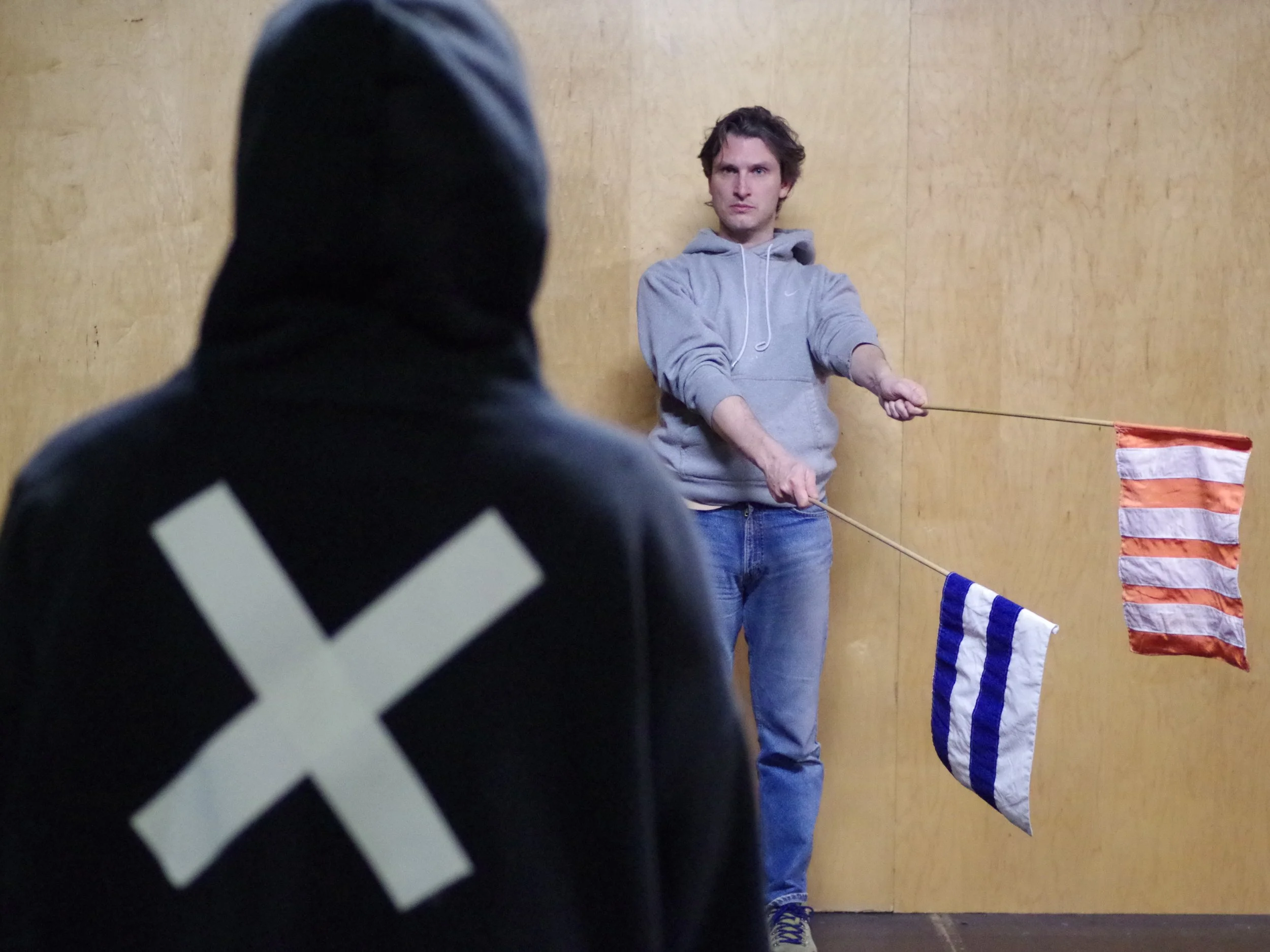
photo: Object Collection
Kara Feely
It's funny that we use that word experimental, because I guess I don't necessarily feel like what I'm doing is experimenting with anything. Because I know what I want to do, and I'm not thinking, “what will happen if I do this?” I know what will happen. When I do the things that I do, it's very intentional. I get bored watching theater performances that fall into tropes or familiar rhythms, and I think, why is everybody laughing at this? I don't think it's funny. Everybody was laughing because they feel like they should laugh, or why did they feel the need to end the scene there? Or things just falling into very familiar rhythms. And I'm always thinking about trying to make a different choice with that. So I guess maybe that is experimenting, but I guess I don't think of it in terms of what I'm doing, because I know what I want to do. When you make a strange choice in terms of your piece, or with the rhythm of it, or the way it unfolds, sometimes that kind of creates a sort of energy that is really, really exciting. And you kind of know it when you're working on something. Like the scene that you're describing of Jeanette following you around with a flashlight, and suddenly you think, this is amazing! You know when something is working and this is really exciting. And I don't really know why, but we've hit on something, and I think that this sort of teetering point of catastrophic failure there, where this could just go belly up, but it's instead somehow lifting in an exciting way. Whenever that happens, we always try to jump on that and keep that going.
Travis Just
I think we commit to things, and then we go all the way with them. It might be a really long section of a piece, and it may be terribly aggressive, or terribly boring, or terribly ridiculous, but we've committed to it. I'm not interested in valorizing the text above all things, having the performance be an honest realization of this very well defined text. I can't imagine anything more dull than that. So there is always an element of where, when we do it in the show, I just have to trust that, say, Daniel, Yuki and Nico are going to figure it out on stage, they're going to pull something. Or maybe I write this really stupid thing, I have this idea for some vocal notation. It's not very good, but I know if I give it to Avi, he's gonna do something with it. I think that goes back a long way. I mean, Duke Ellington is not Duke Ellington without Jimmy Blanton and Ben Webster delivering the goods night after night.
Paul Pinto
And it’s not a new idea in opera, right? Whatever that word means. The score is one part of a vehicle of transmission. It's not the only thing that transmits.
Travis Just
I think it is something that has shifted, and I hope it is a permanent shift, away from that kind of 19th and 20th century idea of very much valorizing the score or the text. There are plenty of plays that are all about the word on the page or whatever. Opera… I stopped using that word for my own work many years ago. In my heart, I'm still very much committed to it, but I just can't be a part of what it is in the culture, I just don't want to be part of that. But, musically, I do very much see my work that way. I mean, there's music, there's text, there's theater: that's opera, that's what it is. But if there's going to be a future of opera or theater, it has to let go of those things. It has to acknowledge where we are at this point in history. It's always shocking to me, the amount of work that doesn't. I just can't believe it. I can't believe that people are writing it. I can't believe that people are listening to it. It just blows my mind. But what do I know? In a way, it's like seeing Mano a Mano, nothing else could be like this, but everything should be like this.
Paul Pinto
Can't we hope that for all pieces: I don't want everyone to write a work like this, but I'm glad that this exists. There can be nothing else like this, and now I can't unsee it as what theater can be, or opera can be. I think of [Object Collection’s 2011 piece] Innova in this way? I can't unsee this opera. I can't unpair Innova from what opera should be, right? And I saw that piece so many years ago.
Kara Feely
You were one of 20,
Travis Just
Yeah, you want to talk about poor attendance. Let me tell you, we hold the record. That fucker was three hours long. We had shows where there was one hour per person in the audience.
Kara Feely
To some extent, you sort of have to feel that I don't have anything to lose, because as you're starting out, you have nothing, and I still kind of feel that way.
Travis Just
I very much feel that way because there's nothing to gain. I don't expect any level of success. There isn't any for the kind of work we do. We're very fortunate to be able to continue making it, but there's no award at the end of this road. And good. I don't make that kind of work. I don't want to make that kind of work. It's very freeing to just get rid of all of that. I studied with James Tenney, and he would talk about the idea that when nothing's at stake, you can do anything. And I think that's a very liberating thing. And so in this moment when nobody writes about it, there are very few platforms, there are vanishingly few venues. In a way, that's maybe one of the best situations for the art. It's better if people don't go into a show thinking “this is going to make my career if I can just get that review and then book that gig”. How boring. I just want to know about the thing you're making. I don't give a shit about you climbing the ladder. Kick the ladder away, burn the ladder. Much better without ladders. No ladders, no leaders.
Paul Pinto
At the same time, you're talking to me like heroes. And I am talking about, man, I want to kill my heroes. But here you are talking like a hero to me at the same time.
Travis Just
No heroes, just people. No heroes, just people.
Paul Pinto
Just people. I don't give a shit about reviews. I don't read them, I don't read other people's reviews. But there is a reality that I spent eight years making this work, and I want to do it again, and there's still a sting that an opera I made in 2017 that I spent a lot of time on has never been performed again. And I feel like, if there's something that's changed in me, it's that I want to go slower and ensure that everything I do has a life beyond the first time I do it. And press, unfortunately, is one of those things, one of the gatekeepers. Not of the whole thing, but it is one of the gatekeeping factors. Sometimes I want some reassurance, not that other people find it valuable. I feel like I find value, but that there's a way that I can continue paying everyone that worked on this project for the next year.
Travis Just
I always think our work: it's for anybody. It's not specialist work. It's for anybody. But it's definitely not for everybody. Anybody can come in and see it. Honestly, when we've been on tour a lot of times the professionals in the audience, you know, the curators and the other touring artists, they'll sort of sniffle their noses at us, but the people who work the door, the kids working the bar, they're the ones that will come up and say “that was amazing”. But the professional curator from wherever, they'll say, “I don't know…” I know which audience I'd rather have.
Kara Feely
I have such bizarre reactions and I take away such strange things from pieces that other people don't take away. And I feel like I would never presume that everyone is going to be getting the same thing from my piece. They may wildly misunderstand the theme, but we've always made pieces that allow you to have any of those reactions, you can still experience it and in that way, I feel it is accessible, although I'm sure many people would say it isn't. Because I'm not expecting you to get any one thing from this piece other than just to take it in, and have a night, and have thoughts of your own.
Travis Just
Maybe there is a proselytizing aspect. If there was an overarching project, it's this idea that by doing this enough the culture can be radicalized. Like little bits of light here and there, what's the phrase…little drops move the ocean, or some fucking thing. It's just doing our little bit to say: I'm not part of your algorithm, because I literally am not involved in it. I might be subject to your police state, but I fucking resist every aspect of it, and I exist outside of it. And if you come in, because I'm from Minneapolis, right, if you come into my city and try to impose it, that's not going to fucking fly, and it stops now. I think that there's something, there's a certain refusal that is galvanizing.
Paul Pinto
The galvanization really lands for me, because the idea of doing a thing loud enough and often enough that people think this is the water. This is what it is to go out and have a night in theater. This is what it is make political art. This is how much we should spend on a slice of pizza. If enough people start changing this, then it does change the culture.
Travis Just
I think that's the thing that's so effortless about Mano a Mano that you did, just to sort of bring it home here, maybe, at the end. That it doesn't feel like anything that you recognize, but it feels so comfortable. And that's sort of its magic, in a way, that it could be a tradition unto itself. And it doesn't feel labored in any way. And that's in and of itself interesting. And one reason I thought it was so successful.
Mano a Mano: an operatic monodrama by Paul Pinto closes Sunday, February 22 at La MaMa ETC and Actua 1 by Object Collection runs March 12 - 22 at Collapsable Hole