
Staff Picks Talks PRACTICE
Practice is bound to be one of the season’s most polarizing shows, loved and loathed by the people it’s about: theatermakers. Who would want to work for a manipulative, egotistical theater guru? And yet, who hasn’t worked for a manipulative, egotistical theater guru? Many Staff Pickers have seen Nazareth Hassan’s world premiere, now at Playwrights Horizons, and they sound off below. Spoilers, and hot takes, abound.
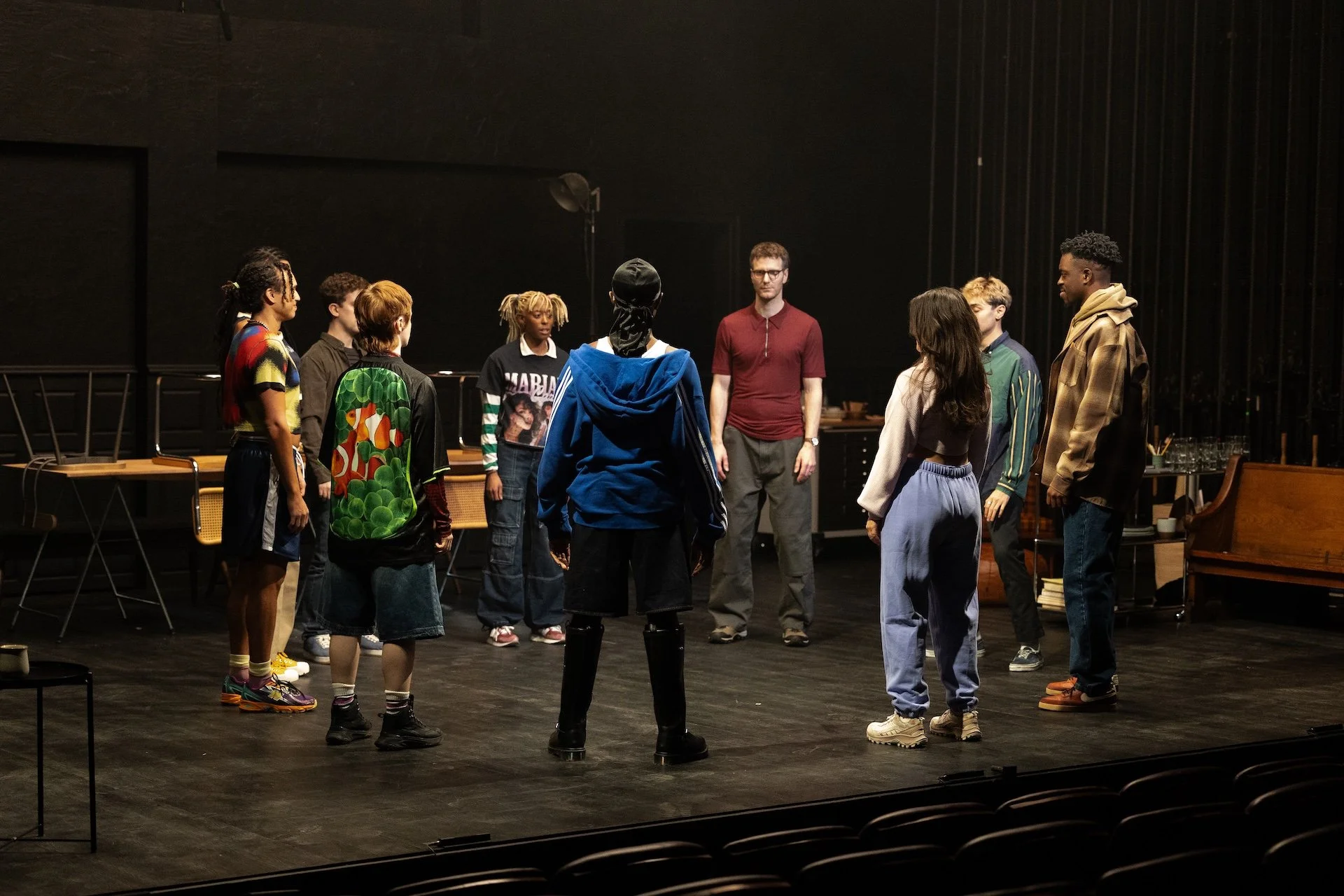
Ensemble of PRACTICE / photo Alexander Mejía, Bergamot
Billy McEntee
I want to highlight something the play got right: what Americans think Berlin experimental theater is. Sorry, I need to pause and swish around some mouthwash because “what Americans think Berlin experimental theater is” alone should have me retching at its uber-high sense of pretension. And yet, that is the kind of theater Asa Leon (Ronald Peet) strove to make. It is the stuff of SNL parody: actors costumed in Arrival-esque spacesuits, simultaneous speaking of a director’s diary entries, lines set (for no reason at all) to minor-key singing, bodies writhing around in physical feats impressive but hollow. But, there is a glorious design: the box the actors seize in is lit to perfection. Bananas at BAM’s budget. That, too, feels accurate.
kanishk pandey
Bear with me on this. There’s this aphorism by Adorno wherein he makes the claim that the instinct to slam a car door can be tied to fascism. It’s mocked a lot because how can something so small and everyday be tied to philosophies of genocide and control? However, I’d argue the ability to hold a microscope up to the animalistic spasms of human beings that trend them towards cruelty and control is how we avoid falling into those potholes. Practice does this through the lens of a type of theatrical process. If you’re a theatermaker, you may see this show and feel as if you are seeing an amalgamation of your own experiences in different rehearsal rooms, residencies, workshops, and productions, forming a highlight reel of pain, shame, and uselessness, all threaded through the needle by which one’s individuality and identity can be plucked out by a collaborator via just a few well-aimed words. I know I did. That said, I felt inclined to see the show more as an example of how impulses of control and subjugation bubble underneath the human psyche. All the language we throw around to promise ourselves we treat our collaborators kindly can be manipulated by an artist with an eye towards control. Gestures towards self-awareness can help protect an abusive leader as long as the subjugated follow suit. I think this show utilizes the theater world, and its many awful people in powerful positions, to allude to a universal danger in our culture. Just as Adorno questions “which driver is not tempted, merely by the power of his engine, to wipe out the vermin of the street, pedestrians, children and cyclists”, I felt Practice questions which lead artist is not drawn to cleansing out the identity of each of their collaborators to turn them into the manageable objects by which a sole voice can dominate. And I’d argue there’s something universal to that question. Something past just the inside baseball of our theater world.
Reuven Glezer
I think I’m in the minority of my peers when I say (gasp!) that I did not have an intensely manipulative arts icon/acting professor/pretentious narcissist in designer fits in my life who drove me mad with adoration and repulsion. However, we’ve definitely sighted an Asa Leon from a mile away, lauded to death, drowning in the glory of MacArthur grants and “recognition” for what we know is bullshit. And it is bullshit, right down to the jelly beans. This isn’t the next Ralph Lemon but like if David Koresh saw a Rimini Protokoll show and went, “Yeah.” See how these performers, these people—and we lose so much sight of their people-ness through the work—get stiffer and stiffer, how they line up evenly against the lip of the stage. Artist as emotional parasite, as personal fascist. Also, Schauspielhaus Scheiße…we’ve all got one, don’t we?
Marissa Joyce Stamps
When performing a scene in undergrad, I remember I had a professor who didn't quite like what I was doing and stopped me and my partner midway. He asked me, “Why do you act? Why are you in this profession” I said, “To represent and uplift my people—Black people.” He said, “What? That’s it?...” And we went on this whole back and forth until his persistent gaslighting tore me down to tears and he told me to get back into the scene, to which at the end he said was “better.” That is one of the few things of my past that I resent—letting that man make me cry and try to twist me into something I was not.
I resent that I had for one second actually believed I was something I was not.
I had the surreal pleasure of watching Nazareth Hassan’s Practice with some friends I went to undergrad with (Hassan being one of them (for transparency)). And, while watching it I thought of the many ways in which theatre trauma is siphoned from its people for the sake of good art. Good anything, really. That if you don’t cry or feel pain or feel discomfort uncomfortable or expose yourself in the rawest ways—some of which you hadn’t even shown yourself—then, you are a bad actor, a bad collaborator, an unworthy human. That the real sacrifice is the sacrifice of your safety and personhood. You must be moldable.
Spoilers ahead! Act II, or Self Awareness Exercise 001 (an amalgamation of characters’ vulnerabilities from Act I in play-form written by their cult leader/director Asa Leon (Ronald Peet)—offers many symbolic interpretations of what its one-way mirrored, four-walled room (beautifully designed by Afsoon Pajoufar) can be. But, the one I find myself most propelled by is even with a mirror in front of me, a thing that cannot lie, why is it that I—a person who is so unknowingly indoctrinated by the system[s] I have devoted myself to—can no longer decipher who I am, that I am unable to mask and look at myself, knowing the totality of my truth and walk out?
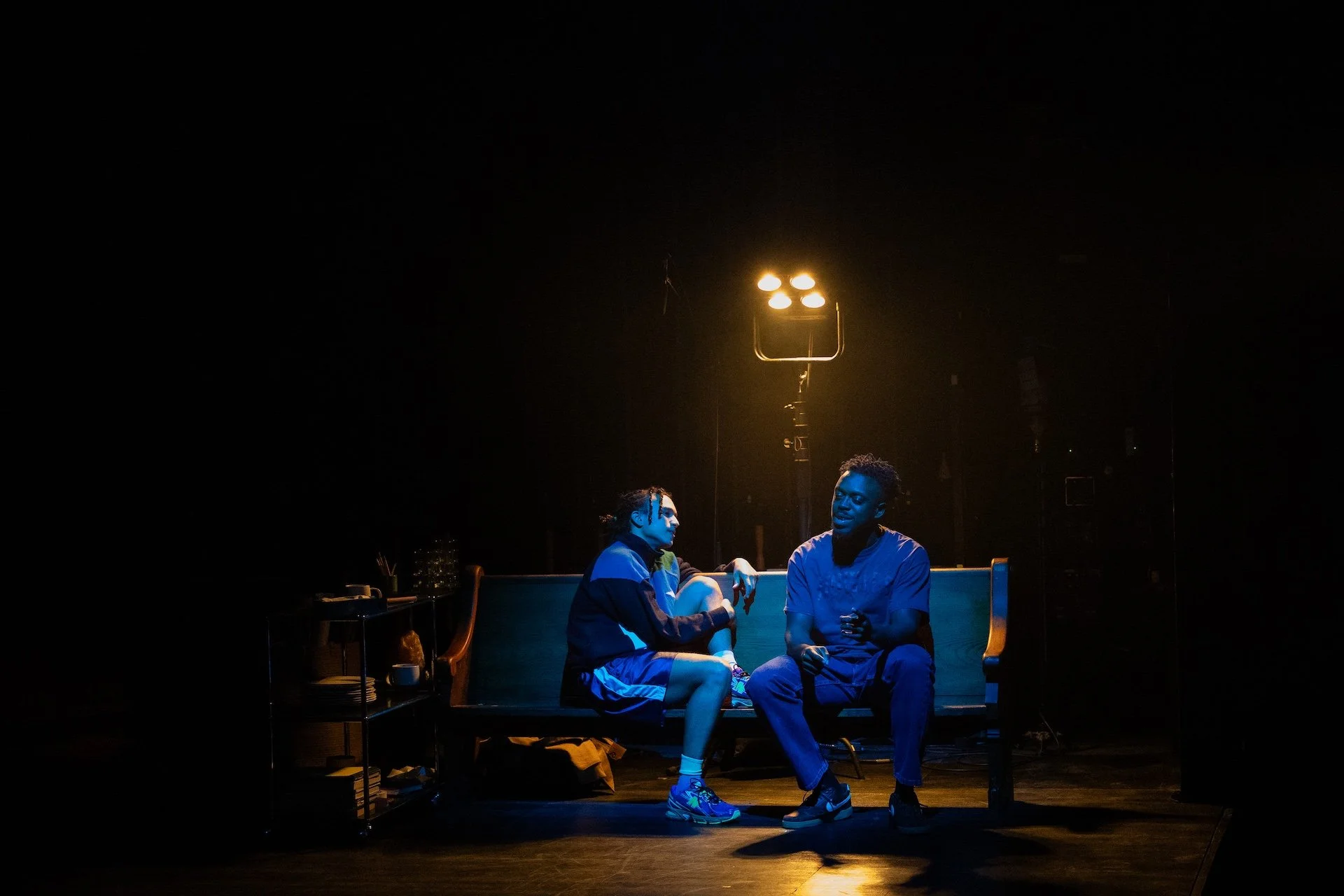
(L-R) Hayward Leach, Opa Adeyemo / photo Alexander Mejía, Bergamot