
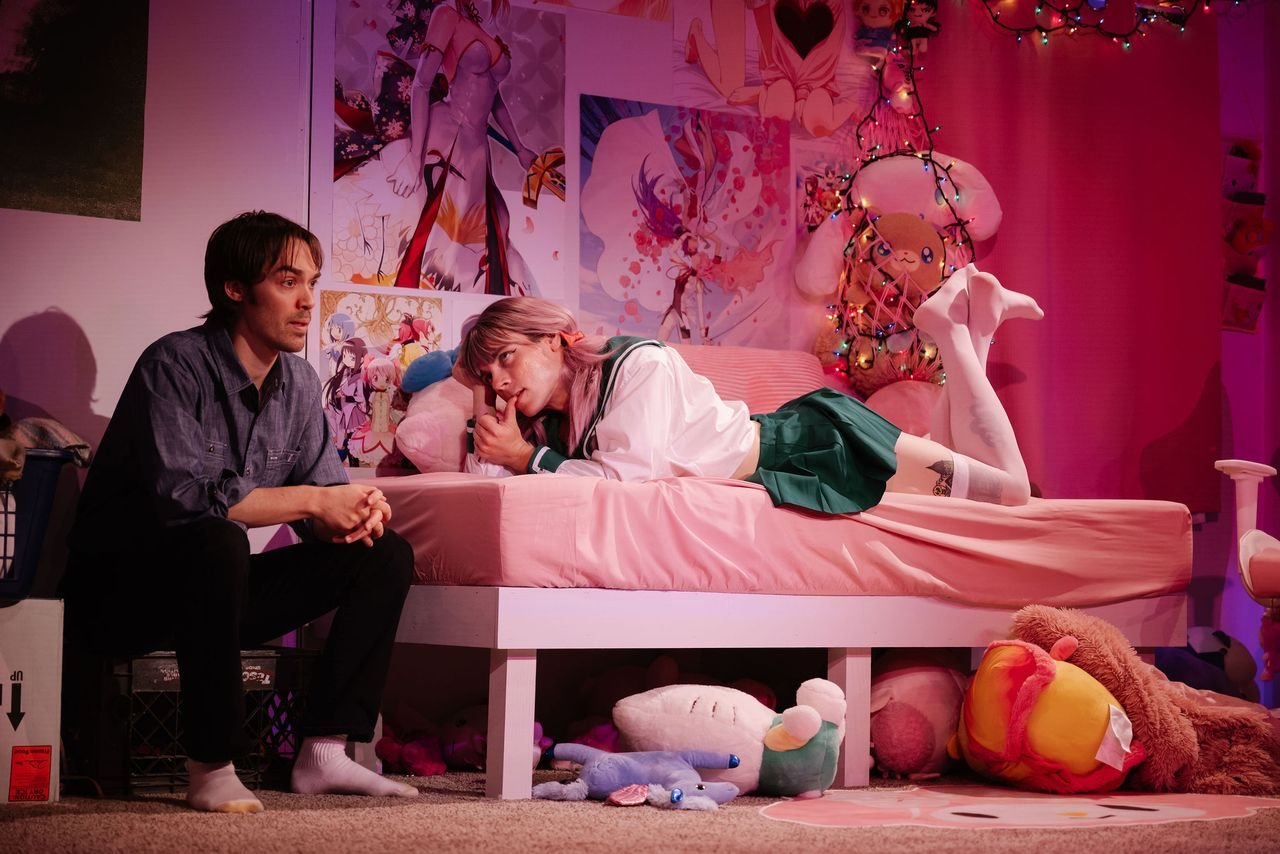
L to R: Zachary Desmond and Christopher Dylan White in Degenerates. Photo by Jackie Abbott.
I had never bought a theatre ticket for a sex scene. Then came Degenerates. Word on the street was that the sex in Degenerates was outrageously good, which I had no doubts about, because it is choreographed by my friend and collaborator Willow Funkhouser, who is extraordinarily talented at intimacy choreography. By the time I left Playwrights Horizons the night I saw Degenerates, Willow and I had a Soapbox interview in the calendar.
Leah Plante-Wiener: Good morning, Willow!
Willow Funkhouser: Good morning!
LPW: It’s obviously super exciting for you to have this project at an Off-Broadway institution that’s receiving quite a lot of attention, but your work as intimacy choreographer, specifically, is receiving attention. Sara Holdren in Vulture was like, and the sex scene in the middle! and named you. What have the last few weeks been like for you?
WF: It’s super special that everyone has been liking Degenerates so much. I had a feeling that people were gonna really like the play. When I first read the play, I was like, this is excellent, and this is exactly the kind of thing I want to go see, and the sex scene is the sex scene, but the whole play is intimacy. It’s not like there’s this one interjection where we get access to the intimate sexual lives of these people. Their sexual life is their life.
LPW: Or lack thereof.
WF: It’s been cool to see that people want to see sex on stage. They’re into it and they’re not scared off by it. At first, I thought that maybe my seventy-year-old aunt and uncle didn’t need to see this one, but at previews, there were a lot of grey-haired folks in the audience, and they were eating it up. They’re gasping! They’re shocked! Sex is for everyone.
LPW: There were some older ladies behind me when I saw it.
WF: The other cool thing has been how much of people’s reactions end up being about their bodily experience. People will be like, it’s intermission and my body feels insane.
LPW: I’m going to repeat what I texted you during intermission, which was that my intermission cigarette felt like a post-coital cigarette. I think it has to do with the structure of the first act, which is all hinged on tension and ultimate release. And it edges us like crazy! Then, finally, we get the release, and there is the bitter disappointment of what happens immediately after, the disappointment of a dude ghosting you and going, sorry, I have issues and can’t deal with you. My body was on a psychosomatic sexual journey that it already knew so intimately.
WF: I think no one expects to go in and have it feel relatable, but it’s relatable! My straight friends relate, my queer friends relate, my trans friends and my cis friends. It’s universal in a way that I think is surprising.
LPW: Ultimately, when it comes to bodies and sex, we’re all kind of weird about it. That’s what is especially miraculous about the intimacy choreography in Degenerates. You capture the awkwardness and inhibition, and it’s all there in the gesture and the body. It’s a masterclass in intimacy choreography as storytelling.
WF: Thank you. I will say that so much of what you’re seeing, conceptually, is from what Else and Emma [Went], and Christopher [Dylan White] and Zachary [Desmond] have been working on for years. I was the very last addition to the team that was building the sex in the play. A lot of those gestures, especially in the lead-up to the sex scene, had been things that they had built prior to my involvement. I was either giving little suggestions or tweaks. So, I want to make that super clear. When Emma and I first started talking about what our collaboration was going to be, she was like, the actors and I have been working together a long time. The trust is there, and the actors are already game. What she wanted was somebody to help her execute the technical choreography of the moment. Else, Emma, the actors are incredibly brilliant, verbal people, and getting what’s going on in the brains into the bodies was the work of our one big day of devising, where we built the shape of the scene together.
LPW: What you’re doing is an act of translation.
WF: Yes! I think that is totally a piece of it. That was one of the most collaborative days I’ve ever had in rehearsal as an intimacy choreographer. Everyone was throwing out ideas, and Else, who’s also a sound designer in her own right, was live mixing the sounds that you hear from that song–
LPW: Sophie’s “MSMSMSMS”.
WF: –While we were playing. It was an incredibly full, rich day of ideas and generation from all.
LPW: And I will say, it’s not just the sex scene itself that has your mark, right? When I texted you during intermission, we talked about the moment where Miller sucks on Target’s fingers during the phone call, which is so… oh my god. We need more finger sucking in theatre.
WF: Christopher and Zachary met on the day of the play’s first reading, which I believe was back in 2022, and I had heard from Emma that the gesture where Miller nuzzles into Target’s hand during the phone call was something that came out organically during that first reading, on the first day they had ever met– if that gives you a sense of what I was walking into, in terms of how brave these actors already were with each other. I think that is ultimately the reason we were able to go so far with the sex scene. We were starting on such a high level of trust.
LPW: There’s an exciting but troubling paradox here. You have this work that is being supported by a major institution and that has years of support behind it. It is because of that support — money, access to rehearsal rooms, time with actors, working towards a large production — that these trusting relationships can organically develop, and these are the circumstances that allow an intimacy choreographer like you to walk into a buffet of possibilities.
We’re in this moment where the Off-Broadway nonprofit complex is struggling and has outlived its original 1970s model, but these are still institutions that foster the type of development processes where actors and directors and intimacy choreographers have the time and space to take big swings and stage big sex scenes. Quite frankly, we need to be using these resources to stage a lot more sex.
WF: And to create something that isn’t just sex for shock value– which is fine! I certainly end up working on projects where that is true, but I think what is special about Degenerates and why it’s getting the attention that it’s getting is because the story hinges–
WF & LPW: –On the sex.
WF: Right.
LPW: I think it’s thrilling for sex to be so central in a play that has so many difficultly digestible components. I mean, it’s a screed of hatred every time Miller opens his mouth. It is a strange, squirmy, unsavoury landscape that we’re living in, where we also have the very real but taboo situation of eighteen-year-old Target camming to make a living, which exists in the particularly taboo realm of someone perceived as a young man dressing as a woman for money. It’s all very thorny and uncomfortable, and in the middle of it is this exhilarating sex scene.
WF: It’s really interesting, because there’s so many elements to the scene. It wants to be hot and sexy, and it wants to be a loss of virginity story, which is in a lot of ways in opposition to the hotness and sexiness, and it’s a story about gender euphoria, and what it is to perform gender during a sexual encounter. It’s a queer sex scene, but you want to begin in the story of a heterosexual encounter, because that’s what Miller thinks he’s after. The moment’s only two and a half minutes long, and we have to bring the audience from what if this is straight to it’s definitely queer, and we have to make that land, or else the following beats don’t make sense.
LPW: For me, the gesture of Target in pain and getting Miller to pull out, then spitting in her hand to lube herself up, was the moment that confirmed that this was queer, trans sex.
WF: I remember Emma saying that she felt like Miller removing Target’s wig, which is right before you hear the line “There’s a moment where it starts to work,” is a confessional moment for Miller about what he really wants.
LPW: When I saw it, Target’s wig popped off immediately.
WF: Noooo! Okay, but ideally, in a perfect choreographic world, they’re on the floor and they sit back with Miller’s hands on Target’s boobs, and then the wig comes off.
LPW: So there is a degree of wig choreography.
WF: And there you go. That’s live theatre. Sometimes it’s going to be exactly how we rehearse it, and sometimes it’s going to be whatever the fuck happens.
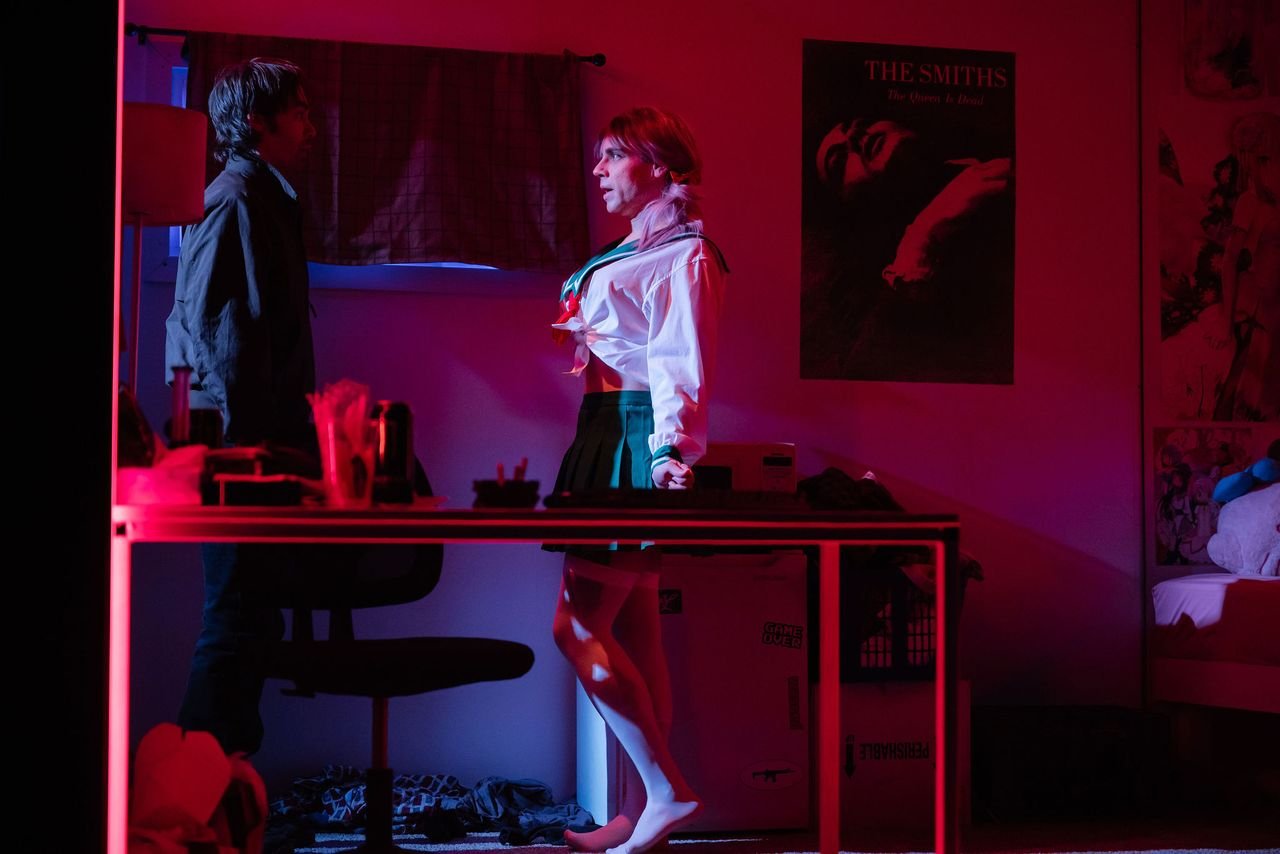
L to R: Zachary Desmond and Christopher Dylan White. Photo by Jackie Abbott.
LPW: Earlier, we were talking about the relatability of it all. Not to say that delight in theatre exists entirely in self-recognition, but that recognition was really delightful to me. As soon as they were in Target’s apartment together, I saw myself in there.
WF: Oh, completely.
LPW: It’s a younger woman, an older man, there’s a substance involved. They talk a big talk online, and then Miller pulls up to the apartment and they immediately have to get so high off the weed pen because it’s the only way they can cope with what’s happening. It’s awkward. There’s such an earnestness to the desire for sex and connection, as well as the hurdles they have to overcome in order to accomplish that. That was deeply relatable to me, and I didn’t expect to come into the show and relate so much to the performance of intimacy, especially the performance of what leads to intimacy.
WF: Else and Emma are brilliant, utterly. In our first meeting, Emma said something like, we have to fuck the audience, or else they won’t care about the fucking. The foreplay is the entirety of Act Two.
LPW: And I’ll distinguish Act Two as the second two-thirds of what happens before intermission, with Act Three following.
WF: Correct. Act Two is this forty-five minute long foreplay for what you’re about to see. Emma, Else, and the actors set us up perfectly.
LPW: It’s very honest foreplay.
WF: There’s no fantasy.
LPW: I was letting a weird hookup into my apartment and deciding to commit because goddammit I want to get laid. That is what was happening to me in my seat at Playwrights Horizons.
WF: That’s so good.
LPW: And whatever fantasy there is is immediately punctured. Miller enters the apartment and the fantasy collapses around them, and they have to sort through the ruins of fantasy.
WF: And put the fantasy back together a little, right? Or else there is no eroticism. Eroticism lives within the fantastical world in our minds. There’s something about high sex as well that is crucial here, to be able to reconstruct the pieces. There’s a line, which I think is one of the best lines in the play, that’s something like “everything real is different than how we imagine it,” and it is. The sex they have is completely different from whatever they imagine it’s going to be.
I think one of my jobs, more broadly as an intimacy choreographer, is that I feel obligated to present depictions of sex that feel like sex that people are actually having. We’ve got enough fantasy. There’s enough of that in the media. You can find it wherever you like. I think what people want is to see themselves reflected during sex. I think it’s really important to do that.
LPW: Sometimes, you’ve gotta spit in your hand and lube up your butt.
WF: Which isn’t any less sexy.
PW: Part of what’s so sexy about the sex scene and the lead-up, and all of the small gestures of intimacy — like Miller taking Target’s fingers into his mouth — is that we are watching them rebuild the fantasy that fails as soon as Miller walks in through the door. And it is inevitable that the fantasy fails. Their fantasy of each other is built exclusively from this online relationship where visual perception is entirely one-sided. Target never sees Miller, and exists as an object of consumption to him before they meet.
WF: I think that’s exactly what Emma was looking for.
LPW: It reads! Target is basically camming for Miller. She gets ready to cam while her camera is on and his is off and he’s masturbating. There’s a degree of performance already imposed on the relationship. Then, they’re in the apartment, and they’re just two people who’ve never had sex. The tension between the enormity of their desire and how badly they want to jump each other’s bones, and how scared they are to do it — particularly Miller, fighting through so many layers of homophobia and transphobia until his desire is so overpowering that he can’t help but act on impulse — that tension is sex.
WF: Yes.
LPW: The whole thing is sex. It’s not just the tension between the two of them that fucks the audience, it’s also the tension between them and what’s in the way of what they want.
WF: Anne Carson has an excellent book called Eros the Bittersweet. She writes that there must be the lover, the beloved, and something in the way, or else there is no erotic life. In many ways, that’s how I try to construct the erotic life of any scene, which exists exactly in the triangulation that you’re talking about.
LPW: That’s so hot.
WF: If it’s not a triangle, you just have a lame, plain little line between two people, and there’s nothing to give it texture or dimension. Anything that gets in the way adds to the erotic tension. It could be a yeast infection!
LPW: You also intimacy choreographed benevolent, the Good Apples Collective production of our friend Sophie McIntosh’s play, directed by our friend Nina Goodheart. That play also contains a really stunning depiction of queer sex, and there is such a triangle there. It’s made tangible in the relationship between Sarah [played by Rachel Ravel] and Margaret [played by Chani Reese] by their circumstances, which are that they’re in this filthy institute being surveilled by both their headmistress and each other, and it’s the early twentieth century, and their entire lives are dedicated to physical labour. So, when they have sex for the first time, there is a puncturing, but one that is very different than in Degenerates. It’s hopeful. It’s an intense breath of fresh air in a room that smells like soiled laundry and botched baby deliveries. I’d love for you to talk about your intimacy direction on benevolent as well.
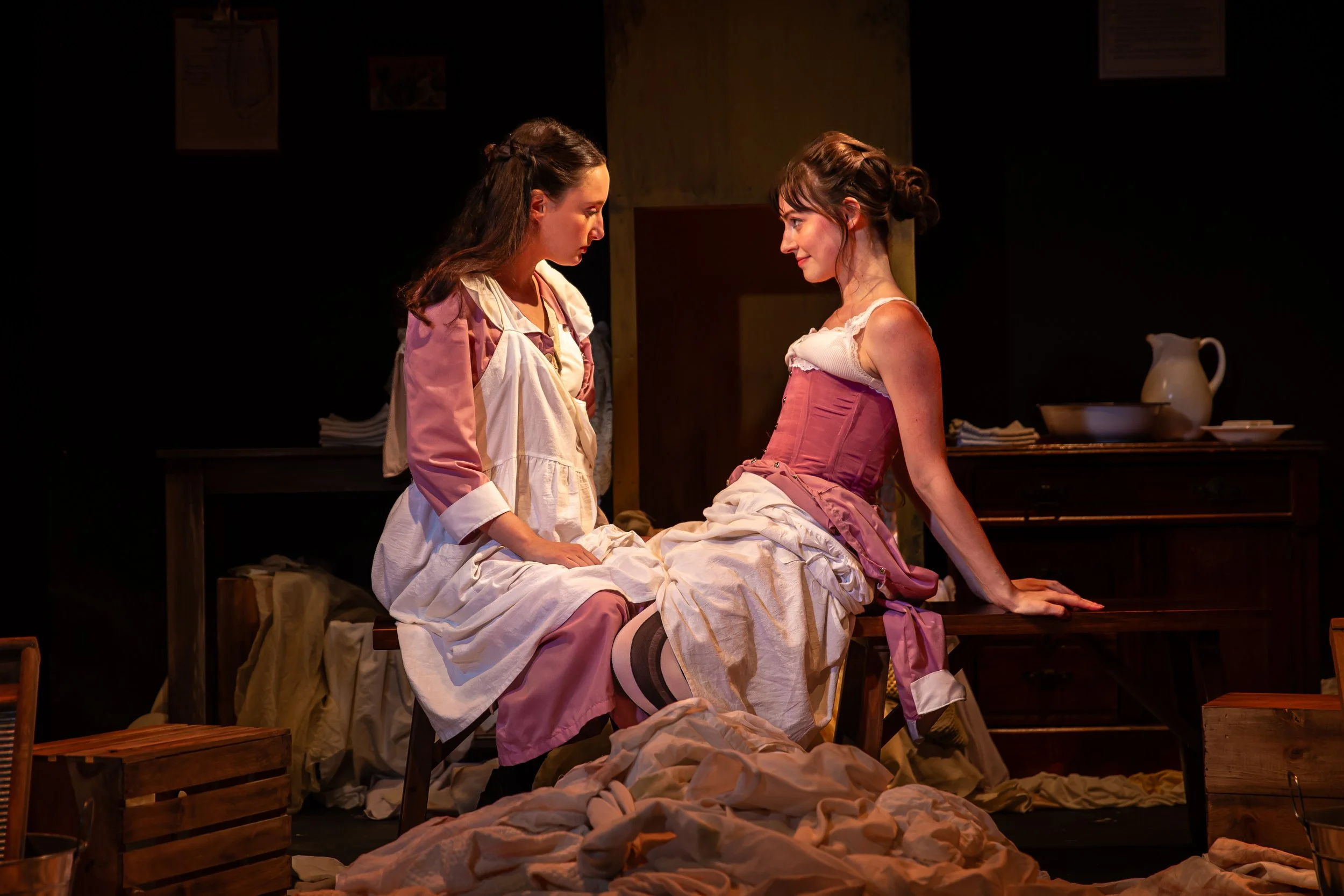
L to R: Rachel Ravel and Chani Reese in benevolent. Photo by Nina Goodheart.
WF: They were such different processes. Rachel and Chani had never worked together. benevolent was more typically how my process works; I come in once they’ve done a little table work and a little blocking. Across almost everything I do, the language I’m bringing to rehearsal to talk about quality of touch is informed by a brilliant intimacy choreographer and coordinator I’ve taken workshops from, Chelsea Pace, who works with skin level, muscle level, and bone level touch. So, we’ll often begin with an exercise that explores those levels of touch. It’s also great because it breaks the touch barrier between the actors and allows them to stop intellectualizing the moment and get into the body, which is where we have to live in order to do the scene. Rehearsals where we talk too much about the sex aren’t going to give the product we want. We have to be trying it and moving. If we’re doing it right, it’s really tiring for the actors.
benevolent had a tenderness and a hilarity that was not our goal with Degenerates. It was a little more straightforward. These are two people discovering their bodies. Sarah is discovering the body of Margaret and in turn discovering her own desire. Margaret’s having maybe her first orgasm ever and discovering that that is available to her, and that all of the sex she’s had with men up until this point doesn’t even come close to what she can find with this woman. There’s a loveliness and sweetness there that is so differently fun from Degenerates. When I’m watching the sex scene in Degenerates, there’s a bit of a tightening and closing in for myself, in wanting to protect myself from the rawness I’m seeing onstage. I think the designers help so much with the need for a barrier, as well as the narration from Olivia [Rose Barresi]. So, you’re able to get a little bit of that space, which you really need. With benevolent, there doesn’t need to be anything. I feel more of an openness when I’m watching that sex scene, because I want to lean forward into the joy and pleasure that is this first sexual encounter.
LPW: And there are so many great moments of tenderness between Sarah and Margaret following that sex scene, whereas in Degenerates, we’re plunged into this transphobic brutality that Miller subjects Target to after they have sex.
WF: Whereas Margaret–
LPW: She’s like, whoa, shit! I’m a lesbian!
WF: She’s stoked that she’s had her first orgasm, and to top it all off, she’s not pregnant, because there’s the blood on Sarah’s hand.
LPW: They get to spend so much of the rest of the play being so sweet to each other.
WF: Of course, that triangulation continues. The third point of the triangle grows in a big way as they’re getting nearer to what might be the end of their stay, and they’re wondering if they’re going to continue on with this or not. There’s so much pain and hurt there, but you needed them to have this euphoric sexual encounter in order to buy the pain later.
LPW: There’s really no need for aesthetic distancing in that sex scene. It’s a love story. Target and Miller is… not a love story.
WF: Or is it?
LPW: I mean… I think it’s a lust story. It’s painful in the ways a lust story is. It’s so painful when Miller rejects Target after they have sex, when Target comes in from the bathroom and Miller gets caught putting his shoes on, and his belt’s not even buckled yet. When he says, “I can’t look at you.” Ugh! Gutting.
WF: It hurts so bad.
LPW: And you feel for both of them. Ultimately, Miller is a really pathetic character, and I mean that in every sense of the word. He does evoke pathos. You’re like, my god, this guy is never going to get over his shit. He finally has this moment of real intimacy and he gets in his own way.
WF: Else writes in her program note about what happens if you receive love you’re not open to. What does it look like for an unlovable person to be loved? I agree with you, it’s a lust story, but there’s love, to me. I think the play loves the characters. Maybe it’s not their love story, but there’s a lot of love in the room.
LPW: What do you want to choreograph? What are your dreams as an intimacy choreographer?
WF: I’d love to work on a film that has the kind of process that I have been afforded in theatre. I love working on film, but I find that the process is not always conducive to making excellent, thoughtful, nuanced sex scenes. I hope I’m able to find collaborators who are interested in doing that the way I’m interested in doing that.
Theatre-wise, my way in is always dance. The sex scene in Degenerates isn’t a dance scene, but for me it is. There is a follower and a leader and a slickness we must achieve in the movements that can only come from rehearsing like you would a dance. I’m interested in projects that would allow me to work with dance and sex in a more visual way. I’m also interested in abstracting sex, and sex between two people who are apart. Really, it all comes down to the play. I want to keep on working on plays that I think are excellent and are dealing with sex as their main problem.
LPW: It’s the engine.
WF: Sex must be the engine.
LPW: I feel like in New York, we see a lot of plays where there’s a lot of talking about sex, but the eroticism is simply not present. The tension is not present. Sex is not an engine for the play, it’s not in the flesh of it. So many plays think that they’re about sex, but it’s just set dressing, and then the sex feels out of place or purely for shock value because the creative team can’t get out of their own head about it. I think that when people succeed at making plays that are sex like Degenerates is, it’s because the creative team has a very precise understanding of theatre as a constant dance between the play and the audience. This director that I love and have worked with, Sammy Zeisel, once said that theatre is mutually embodied presence. Theatre is about its audience’s bodies — more than their brains, I’d argue — and that’s why Degenerates works so well. The play is fucking the audience. And then you go smoke your cigarette and you feel like you just got fucked.
WF: And the thing you were talking about a little bit before — about plays where there’s a lot of talk about sex and then sex is interspersed in an ornamental way — it’s not good storytelling and it’s not titillating. It should be both of those things. As you put it, the buffet of options for an intimacy choreography is so much more tangible when you have a play that cares about the audience’s experience of sex.
LPW: That flew by. I could talk about this forever.